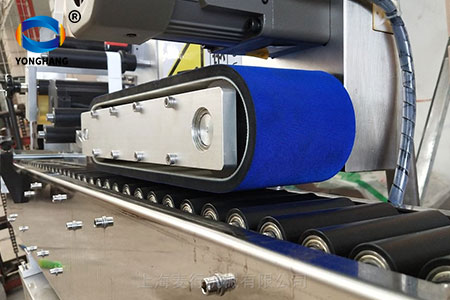
In automated production lines, the standard choice for surface-mounting accessories is usually a false teeth timing belts or a ATN timing belt with nut inserts. So how do you decide which one to choose?
This article will analyze the structural advantages, application scenarios, operating stability, service life and cost performance of the two solutions, helping you quickly select the most suitable matching scheme for your automated timing belt system.
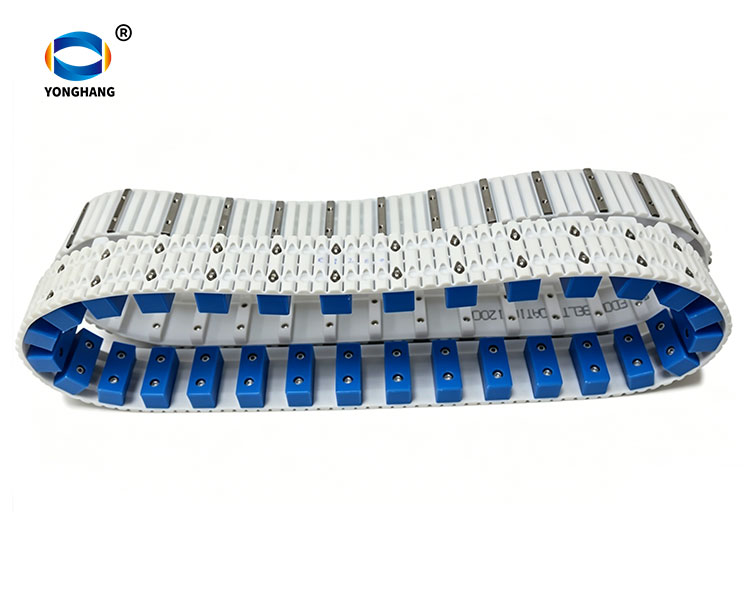
What are Fake Teeth Timing Belts?
A false-tooth timing belt is a specialised design based on a standard timing belt, featuring false teeth (which may be made of stainless steel or brass) positioned at specific locations on the belt body through processes such as milling and punching. It is used to directly secure jigs, stops or positioning components, enabling rigid synchronisation and high-precision positioning between the jig and the belt body. Its key advantage lies in the fact that the belt itself still relies on meshing with the pulley’s teeth to provide slip-free transmission, ensuring a constant transmission ratio, whilst the false teeth enable precise positioning and conveying functions.
Structure and Operating Principles
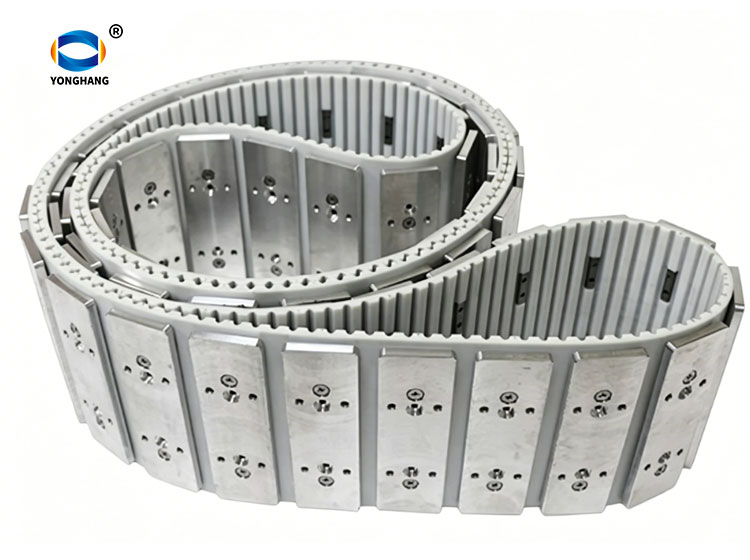
Tooth-replacement timing belts typically consist of three parts: the belt backing, the tensile layer and the teeth. The belt backing is made from materials such as thermoplastic polyurethane (TPU), which offers good flexibility and wear resistance.
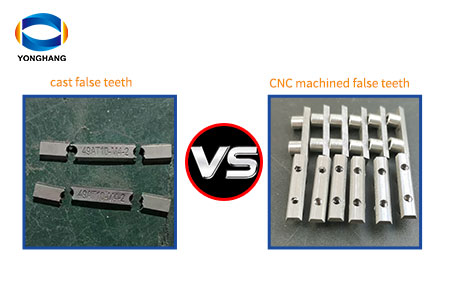
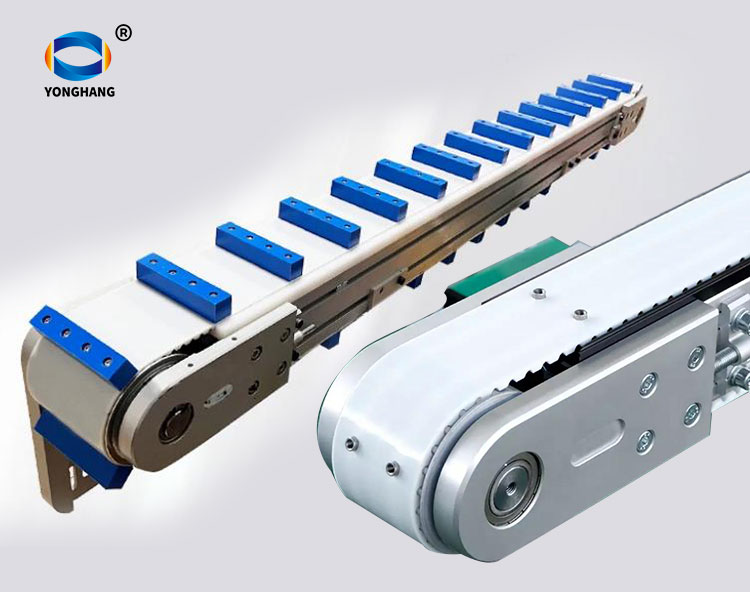
The key structural feature involves removing part of the tooth profile from the tooth surface of the timing belt and then embedding precision-machined metal false teeth, such as stainless steel. These metal teeth maintain the same tooth profile as the belt body and feature threaded holes, allowing fixtures or tooling to be secured directly. The drive unit uses transmission components (such as the timing belt and pulley set) to drive a pusher block or fixture to lift or move.
The false teeth and pusher block are fixed on both sides of the timing belt and move in synchronisation with it. This type of meshing transmission offers excellent smoothness, prevents slippage and ensures high transmission accuracy.
Key Features and Benefits
High-precision positioning: The false teeth are rigidly connected to the belt body, ensuring rigid synchronisation between the fixture and the belt. This makes it particularly suitable for linear conveying applications requiring fixed-distance positioning, cumulative positioning, position-triggered actuation and heavy-load positioning.
Smooth and reliable transmission: The timing belt and pulley set transmit power via tooth engagement, preventing slippage and ensuring high transmission accuracy.
Durability and low maintenance: As the false teeth and push blocks are fixed, the frictional force on the timing belt is minimal, reducing belt wear. This minimises dust generation and extends service life. The metal false teeth offer excellent corrosion resistance and long-term rigidity.
Flexible design: Supports the installation of various accessories such as cleats, boards and nut boards to meet different positioning, conveying and protection requirements. The false teeth can be secured via threaded holes with locking screws, facilitating easy installation, removal and positional adjustment.
Wide range of material compatibility: The belt body is typically coated with polyurethane (PU) or neoprene (CR), whilst the reinforcement layer utilises glass fibre cord or steel cord. The false teeth can be made of brass or stainless steel (e.g. 304/316) to suit different load and environmental requirements.
Main areas of application
Due to their high precision and reliability, timing belts with false teeth are widely used in Light to medium load or high-wear environments. These belts feature stainless steel false teeth, which are fitted with threaded holes for connecting various accessories.
Semiconductor and Electronics Manufacturing:
Used in equipment such as the linear conveyance and positioning of wafers and masks, and the linear axis interlinking of AMHS and EFEM systems, to achieve high-precision positioning and stable, low-backlash cyclic conveyance. In fields such as SMT placement and photovoltaic wafer sorting, its micron-level positioning accuracy is of critical importance.
Precision Machinery and Automation:
Used in CNC machine tools, precision instruments, automated production lines, assembly machines and packaging machines to ensure fixed-distance conveyance of components, secure fixture clamping and high-precision transmission.
Automotive Manufacturing:
On automotive module production lines and assembly lines, these systems ensure that robotic arms, conveyor belts and processing equipment at each workstation operate in unison, enabling efficient and accurate production processes.
Medical Equipment:
Used in X-ray machines, CT scanners and laboratory automation equipment, these systems ensure the precise and error-free operation of moving parts.
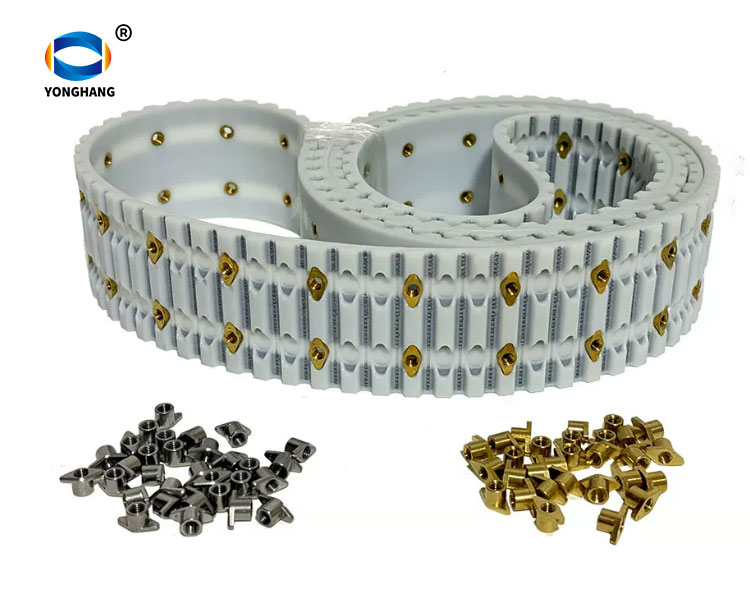
What is a timing belt with rhombus nuts?
Designed for low-load, high-precision automation, the ATN timing belt is the premier choice for precise positioning and custom fixture assembly. It not only serves a power transmission function but also allows nuts and accessories to be fitted through its diamond-shaped holes, enabling the precise clamping and conveyance of materials or workpieces.
Here are a few typical use cases:
Robotic Arms and Automated Assembly Lines
The ATN10 synchronous belt is widely used in robotic arm drive systems. By pre-drilling diamond-shaped countersinks at each tooth pitch, brass or stainless steel nuts can be fitted; these are then used in conjunction with screws to secure fixtures such as baffles and clamps directly to the belt. This method enables the precise positioning of workpieces during conveyance and is commonly employed in high-precision applications such as the assembly of electronic components and automotive parts.
Equidistant Conveying in Packaging Equipment
On food and pharmaceutical packaging lines, products must be conveyed to the sealing station at fixed intervals. By using theATN series synchronous belts, the spacing between attachments can be adjusted in 10mm increments, ensuring that each carton or bottle arrives precisely at its designated position. Thanks to the high precision of the hole positioning (with a theoretical error of zero), stability is maintained even during high-speed operation.
Customers can customize the hole spacing (recommended to be an integer multiple of the pitch to ensure accuracy).
In addition, some equipment incorporates stop blocks with embedded nuts welded to the back of the synchronous belt to push or lift materials, or trigger sensor signals, thereby further expanding its control capabilities within smart production lines
Defect Risk Analysis for false teeth timing and timing belt with nuts
Hidden Troubles of Fake Teeth Structure
Limited by the integral molding process, the bearing tension is weaker than metal nuts, and it is not suitable for super heavy-load traction scenes; customized special tooth shapes require mold opening production, and the delivery cycle of small-batch orders is slightly longer(It is generally not recommended to use tooth profiles and pitches smaller than 8M.)
Hidden Troubles of Nut Matching Structure
1.Long-term operation is prone to nut loosening, slipping and offset, affecting the synchronous precision of the entire timing belt 2.system The protruding nut structure is easy to cause jamming and scratch during equipment operation, increasing equipment 3.failure rate Metal nuts are easy to generate friction noise during high-speed operation, which is not conducive to quiet production 4.workshops The connection part is easy to wear and age, and the later disassembly and maintenance workload is large
Comparison of Vulnerable Points
Common causes of damage to false teeth timing belts: wear and tear of the dentures; deformation due to prolonged heavy pressure
Common causes of damage to ATN nuts inserts: tearing at the drilled holes; nuts coming loose; enlargement of the holes; delamination of the belt
At the client’s request, we visited various factories to conduct on-site inspections. One case left a particularly strong impression on us: the client had originally been using a false-tooth timing belt, but due to the heavy load, they frequently had to replace the entire belt, resulting in high costs. Our engineers recommended switching to a ATN timing belt with nut inserts, which ultimately extended the service life to three times that of the false-tooth belt.
In another instance, a timing belt with nut inserts was replaced with a false-tooth timing belt, doubling the service life. As the production line operated at a high speed, the nuts tended to loosen easily. We recommended switching to a full-length false-tooth belt, which doubled the service life and resulted in significant cost savings.
Final Selection Suggestion for Automated Timing Belt System
- If your equipment focuses on precision synchronization, stable operation, low noise and long service life, and belongs to light and medium-duty automated transmission, fake teeth timing belt is the best choice, which can greatly reduce equipment failure rate and improve production efficiency.
- If your production line needs heavy-load traction, multi-position fixed connection and flexible station adjustment, and the operation speed is low and the tension is large, it is more practical to select the timing belt equipped with fixing nuts.
- For medium-load and multi-functional integrated automated equipment, you can also adopt a hybrid matching scheme according to different station working conditions to maximize the operating performance of the timing belt system.
Yonghang has extensive experience in manufacturing these two types of belts. If you want to know more about actual cases, please feel free to contact us at any time. We have served over 5,000+ actual users of automated false teeth timing belts and nut timing belts. No matter what the working conditions are, our engineers will provide you with the most appropriate suggestions and choices.