MXL trapezoidal timing belts were first developed in the United States in 1964 and have since been increasingly used in mechanical transmission systems
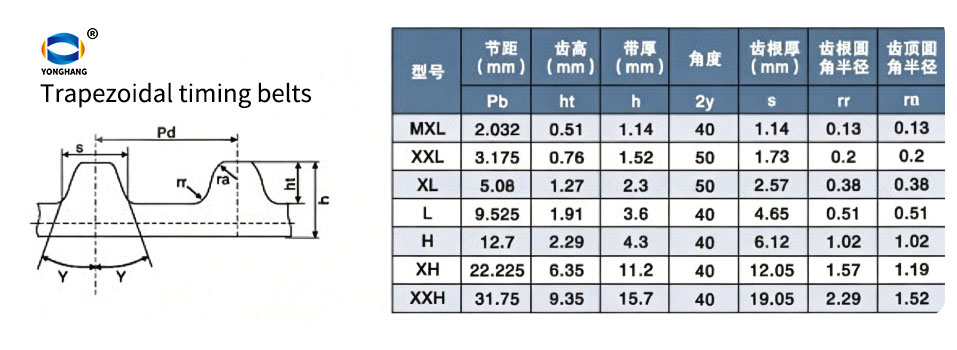
This type of timing belt, featuring a trapezoidal tooth profile, has straight tooth flanks. The tooth profile results in severe stress concentration at the tooth root, which reduces the belt’s service life and load-carrying capacity at high speeds; furthermore, the belt generates high levels of noise and vibration during operation, limiting its operating speed. Subsequent photoelastic testing revealed that the stress distribution in trapezoidal tooth profiles is highly uneven, with significant stress concentration at the root, which can easily lead to tooth fracture and failure. Furthermore, the area of the tooth flank involved in contact accounts for only about one-third of the entire tooth flank, indicating that trapezoidal teeth do not fully utilise the load-bearing capacity of the entire tooth.
In 1973, the American company Uniroyal developed a single-arc timing belt (HTD, corresponding to the Chinese standard JB/T 7512.1), which reduces the polygonal effect of the belt and results in a more even distribution of stress; it has since become increasingly widespread. Subsequently, it was discovered that this arc-tooth design produced noise when speeds reached a certain level, and transmission efficiency declined significantly. In 1977, the American company Goodyear modified this tooth profile into a flat-top arc-tooth (STD) timing belt. This synchronous belt effectively optimises airflow at the moment of tooth engagement with the pulley, thereby significantly reducing the air resistance caused by high-speed meshing.
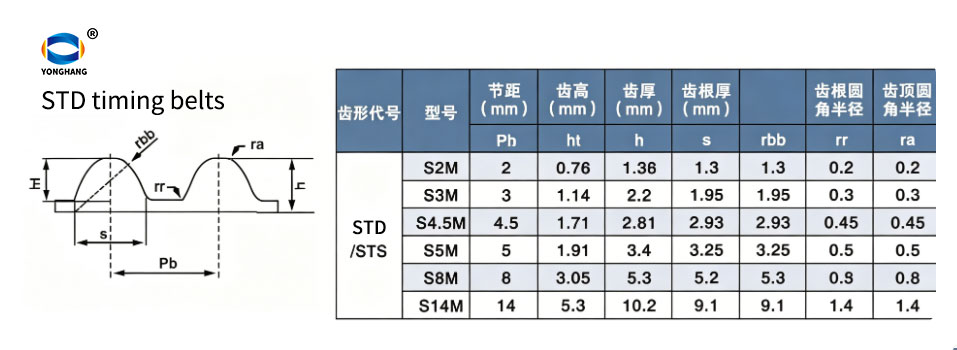
With the rapid development of security surveillance equipment, video conferencing equipment, printers and photocopiers in China, the use of small-tooth timing belts is becoming increasingly widespread. As these small devices transmit relatively low power at moderate speeds, small-tooth belts are commonly used. In addition to low noise levels, the most important criteria are service life and transmission angle accuracy. The MXL-type timing belts, S1.5M and S2M timing belts, meet these requirements perfectly. Currently, MXL synchronous belt drives remain widely used in China, including by well-known manufacturers. However, in Europe, the US and, in particular, Japan, small electronic devices such as financial equipment mechanisms, printers and photocopiers have already widely adopted STD-toothed timing belt drives.
The MXL and S2M timing belts have different tooth profiles but very similar pitch dimensions—2.032 mm for the MXL and 2.00 mm for the S2M—meaning they can be used in the same drive system. I have therefore selected these two belts for comparison to clearly highlight the advantages and disadvantages of these two different types of timing belts. Following over a decade of research and comparison of Yonghang timing belts in financial equipment and security surveillance systems, the S2M outperforms the MXL in terms of both service life and transmission accuracy.
MXL vs S2M timing belt
1.Comparison of tooth profiles
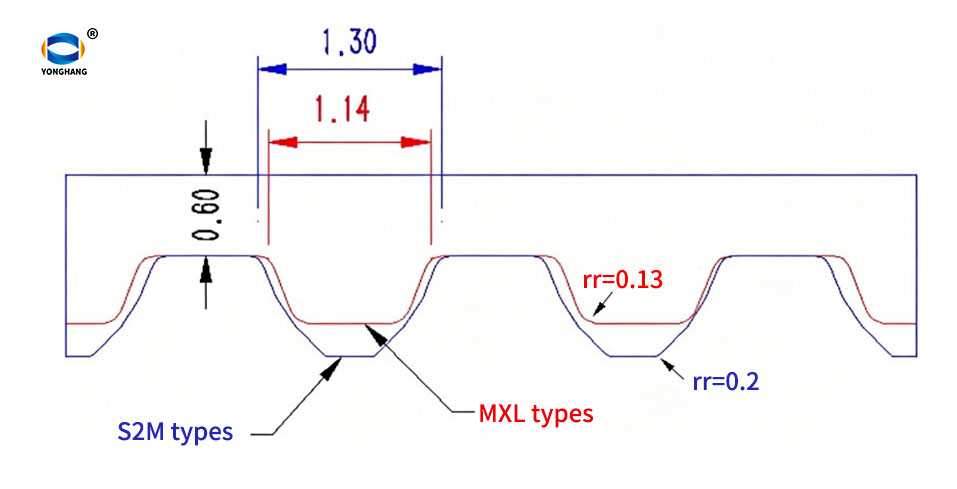
In the diagram below, the dark blue line represents the tooth profile of the S2M timing belt, whilst the red line represents that of the MXL timing belt. The base thickness is the same for both at 0.6 mm, but the S2M teeth are noticeably wider than the MXL teeth, particularly at the base. The fillet radius R0.2 is also larger than that of the MXL teeth (R0.13). The tooth width of the S2M timing belt (1.3 mm) is also greater than that of the MXL timing belt (1.14 mm).
Conclusion
If both belts are made from the same material, the S2M belt offers greater strength than the MXL synchronous belt and can transmit higher power. If the transmitted power is the same, the S2M belt will have a longer service life than the MXL belt.
2. Comparison of Key Parameters
MXL (trapezoidal teeth, pitch 2.032 mm)
Standard gear ratio range: 1:1 to 1:10 (commonly ≤1:8)
Minimum number of teeth on the smaller gear: 10 teeth (to prevent root cutting)
Maximum reduction ratio (single stage): i=10 (e.g. 10 teeth → 100 teeth)
Features: Shallow tooth profile, suitable for light loads + high speeds + precision positioning (e.g. printers, small servos)
S2M (Circular teeth, pitch 2.00 mm, part of the STD/2M series)
Standard gear ratio range: 1:1 to 1:10 (commonly ≤1:8)
Minimum number of teeth on the smaller gear: 12 teeth (lower risk of root cutting with circular teeth)
Maximum reduction ratio (single stage): i=10 (e.g. 12 teeth → 120 teeth)
Features: Thick tooth roots, higher load capacity, lower noise, and greater resistance to tooth skipping (e.g. automation equipment, stepper drives)
3.Meshing condition of S2M and MXL timing belts and pulleys
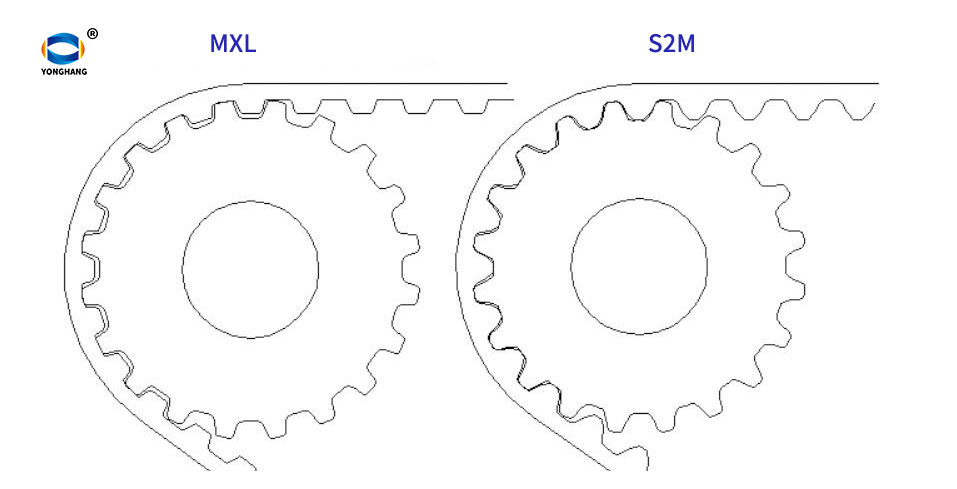
It can be seen that, consistent with the theoretical tooth profile, there is a noticeable gap between the MXL timing belt and the pulley; when the belt is moved back and forth, there is a slight slippage that is clearly discernible. In contrast, no gap is visible between the S2M timing belt and the pulley, and when the belt is moved back and forth, no slippage is visible to the naked eye. The MXL timing belt exhibits a distinct gap both at the tooth flank and the tooth crown, and the polygonal effect is more pronounced than that of the arc-tooth timing belt.
Conclusion
With MXl timing belts, only the tooth roots come into contact with the top of the pulley, resulting in relatively severe stress concentration and lower tensile loads. With S2M timing belts, both the tooth tops and roots come into contact with the pulley, ensuring a more even distribution of forces, which significantly reduces the polygon effect. Furthermore, the meshing of the curved tooth surfaces is smoother, resulting in superior load-bearing capacity and service life for the curved teeth.
4.Field testing
A surveillance PTZ camera was selected to test the accuracy of its preset positions. The camera was driven by timing belts using MXL and S2M teeth respectively; the motor models were identical, and apart from the pulleys and belts, all other components were from the same set. The drive system consists of two rotating axes, as shown in Figure 12. The PTZ camera lens can rotate continuously through 360° around the Z-axis and reciprocate within a 110° range around the Y-axis, both driven by synchronous belts. We selected vertical rotation for testing, with a transmission ratio of 1:4 (20 teeth: 80 teeth). The MXL belt is 180MXL (pitch length 365.76 mm), and the S2M belt is S2M364 (pitch length 364 mm). The distance between the PTZ camera lens and the measuring scale is 15.6 metres. Preset positions are a method of linking key monitored areas with the PTZ camera’s operational status. Under manual or programmed control, the PTZ camera can rotate to any angular position and can be set as a preset position for storage. Recalling preset positions is a standard function of PTZ camera monitoring. Regardless of the direction in which the PTZ camera lens is currently pointing, once a pre-set position is recalled, the camera will rapidly rotate to that preset position.
The test data for the preset offset is as follows:
| Damping Torque (kgf·cm) | Belt Tension (N) | Scale Distance (m) | MXL Trapezoidal Belt | S2M Curvilinear Belt | ||||
| Initial Scale (mm) | Max Deviation (mm) | Angular Error (°) | Initial Scale (mm) | Max Deviation (mm) | Angular Error (°) | |||
| 1.8 | 13 | 15.6 | 890 | 788 | 0.3746 | 676 | 750 | 0.2718 |
| 1.8 | 25 | 15.6 | 952 | 865 | 0.3195 | 772 | 718 | 0.1983 |
| 1.8 | 33 | 15.6 | 952 | 871 | 0.2975 | 633 | 683 | 0.1836 |
| 1.8 | 56 | 15.6 | 774 | 699 | 0.2755 | 684 | 732 | 0.1763 |
| 0.2 | 25 | 15.6 | 690 | 653 | 0.1359 | 642 | 630 | 0.0444 |
Key findings:
- S2M belts consistently deliver higher positioning accuracy across all tension levels.
- Above 25 N, increasing tension provides diminishing returns for accuracy, with minimal improvement above 30 N.
- The S2M maintains excellent accuracy at lower tensions, reducing the risk of premature wear from over-tensioning.
- Lower damping torque amplifies the accuracy difference between the two belt types, with the S2M maintaining far tighter tolerances.
Conclusion
In summary, the S2M flat-top curved-tooth timing belt offers superior transmission accuracy compared to the MXL trapezoidal-tooth timing belt; this is a major advantage of flat-top curved-tooth belts. The installation requirements for flat-top curved-tooth belts are similar to those for trapezoidal-tooth belts, whilst they offer a longer service life and a wider operating tension range.
5.Comparison of tensile strength
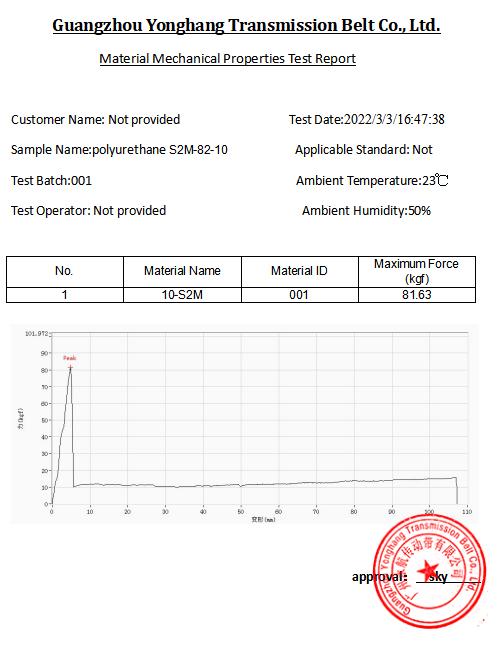 S2M timing belts strain relief test
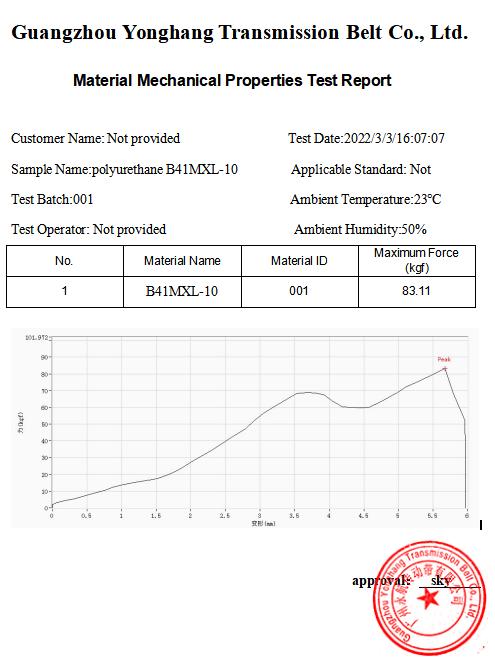 MXL timing belts strain relief test
As can be seen from the tensile test data for Yonghang Company shown in the figure above, although both the MXL and S2M timing belts are made of rubber and have a base thickness of 0.6 mm, their tensile strengths (shown as breaking strength in the drawings) are essentially identical given their identical material composition. But the total thickness (MXL) is 1.1 mm and S2M is 1.31 mm, with the S2M’s thicker tooth profile providing improved fatigue resistance without compromising base tensile performance.
6.cost comparison
From a cost perspective, although the weight per unit width of S2M timing belts is slightly higher, and the cost for the same width may be marginally higher (approximately 1.18:1), they can be manufactured narrower. Consequently, the actual cost is not necessarily higher than that of MXL timing belts; in fact, it can be lower, offering greater advantages in reducing the overall size of the drive system. Based on transmission capacity calculations, a 4 mm wide S2M timing belt can replace the vast majority of 6.4 mm wide MXL timing belt drives, with actual costs potentially reduced by more than 25%.
The Birth of RPP Tooth: A Breakthrough in Parabolic-Tooth Timing Belts (1990 yeas)
In 1994 yeas,Reinforced Parabolic Profile timing belt is born,Product name: RPP Panther, an upgraded version of the STD,At the same time, several transmission manufacturers in Italy, Europe and the United States followed suit by launching similar parabolic-tooth designs, collectively known as the RPP system
Key improvements:
- The tooth crests feature a smooth parabolic profile (as opposed to the circular arcs of HTD or the flat-topped arcs of STD), resulting in smoother meshing and significantly reduced noise;
- The tooth roots are thickened, ensuring a more uniform stress distribution and higher shear strength;
- The profile of the pulley tooth grooves remains consistent across all diameters, allowing even small pulleys to mesh smoothly.
The Popularisation of RPP and Material Evolution (2000s–Present)
Post-2000: RPP became the mainstream tooth profile for precision transmission, servo drives and automated equipment
Material Upgrades:
From neoprene → HNBR/EPDM temperature-resistant rubber (-40°C to +120°C);
Core: Glass fibre → Carbon fibre, offering low elongation and high fatigue life.
Expanded Applications: Industrial automation, robotics, medical equipment, office machinery, power tools, food processing machinery, etc.
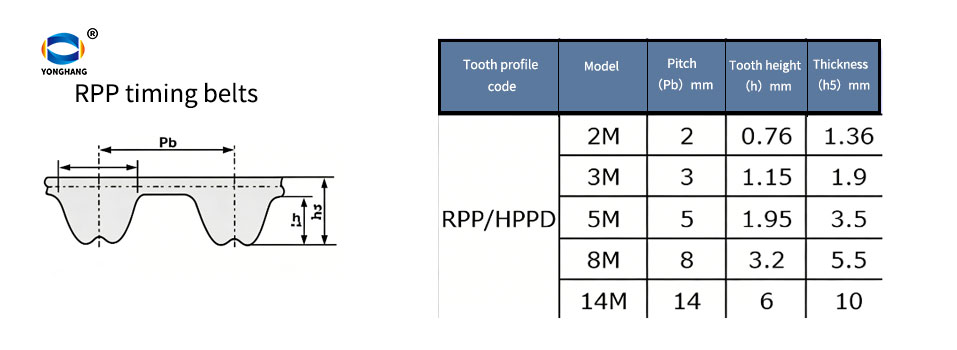
Summary
Our Yonghang timing belts are a product of the modern era, and synchronous belts are one of our factory’s core products. We have conducted in-depth research for many years into high-precision small-tooth-profile transmission applications, such as surveillance cameras, ticket validation equipment, ATMs, large-format printers and printers. We have launched a series of timing belts with small tooth profiles, including 1mm and 1.5mm pitch, 2mm pitch, and other small-tooth timing belts. Should you require any assistance, please do not hesitate to contact our engineers; we will be happy to assist you with product development and selection.