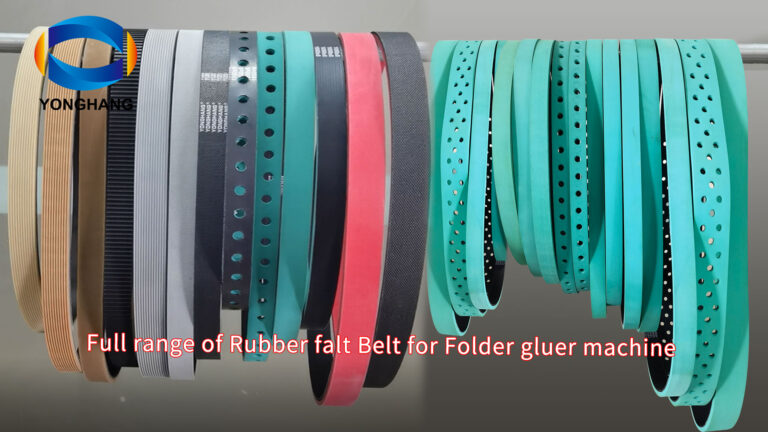
In high-end manufacturing sectors such as automated equipment, precision transmission, food packaging, and photovoltaic and lithium-ion battery production, silicone coated timing belts have become core components in transmission and conveying systems due to their excellent heat resistance, anti-adhesive properties, oil resistance, and high cleanliness. However, when selecting a belt, we often face the first critical decision: should we choose an open-ended (strip-shaped) belt or a closed-loop (seamless/joined) belt?
Choosing the wrong configuration can result in installation difficulties and unstable tension at best, and at worst, it can compromise positioning accuracy or even cause equipment failure. This article will provide an in-depth analysis of the differences between the two, helping you find the most suitable solution.
I. What Are Open-Ended and Closed-Loop Belts?
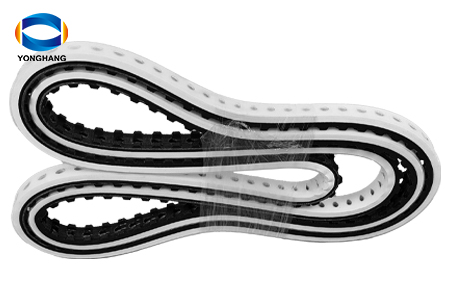
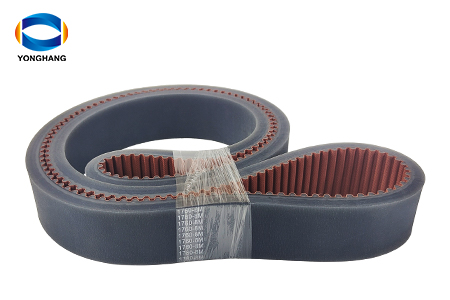
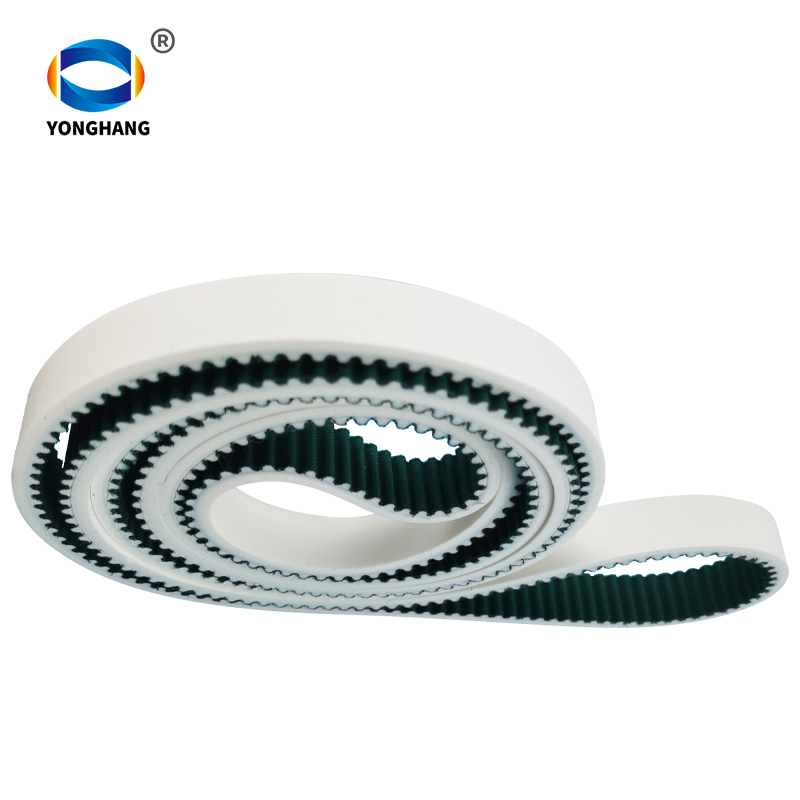
Open-Ended Silicone Coated timing Belts: These typically refer to belts that are not fixed in length and come in long, continuous strips. They usually feature an internal reinforcement layer of steel wire or aramid cord, with a silicone coating applied to the surface. Users can cut the belt to the required length based on the equipment’s stroke, securing both ends with aluminum profiles, clamps, or toothed plates. They are commonly used in linear modules, gantry frames, and other applications involving linear reciprocating motion.
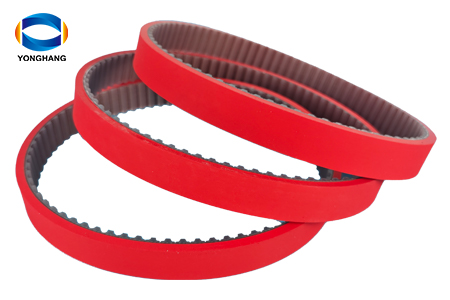
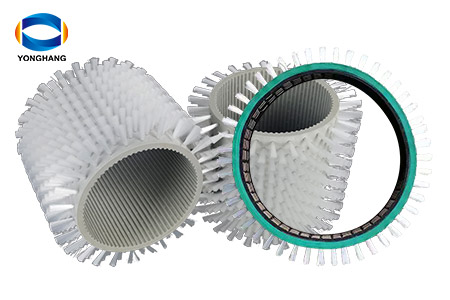
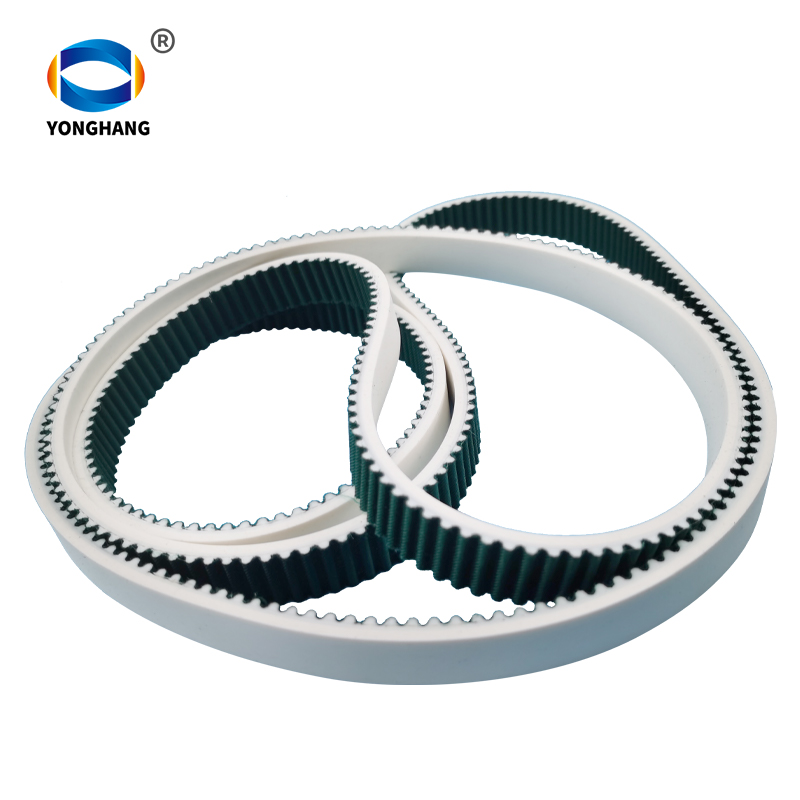
Closed-loop silicone coated timing belts: These are loop-shaped belts manufactured through vulcanized splicing or seamless molding processes. Their length is fixed. During installation, the equipment’s shaft system must be disassembled, and the belt is threaded onto the pulley via a tensioner. They are widely used in continuous rotary motion applications such as material handling and assembly line drives.
II. Key Differences and Selection Criteria for Silicone-Coated Synchronous Belts
1. Application Scenarios for Silicone-Coated Synchronous Belts: Linear Motion vs. Rotary Conveying
This is the fundamental factor determining the selection.
Choose Open-Ended: If your equipment performs linear reciprocating motion (e.g., robotic arm Z-axis, automatic doors, laser cutter gantry), the open-ended type is the only option. This is because closed-loop belts cannot perform “infinitely long” linear reciprocation on open-ended guide rails. Open-ended belts are mounted on sliders and use toothed profiles to mesh with pulleys, converting rotational motion into precise linear displacement.
Choose Closed-Loop: If your equipment performs continuous cyclic conveying (e.g., assembly lines, sorters, packaging lines), you must choose the closed-loop type. The closed-loop design provides continuous cyclic tension, eliminating the need for complex tensioning and reset mechanisms required by the open-loop type.
2. Installation and Maintenance: Convenience vs. Stability
Advantages of Open-Ended Silicone Coated timing Belts: Installation is extremely convenient. For equipment with long travel distances, closed-loop belts can span several meters or even tens of meters, requiring the disassembly of numerous equipment components during installation—a highly challenging process. In contrast, open-ended belts are transported in coiled form, cut to the required length on-site, and secured with clamps, significantly reducing the installation difficulty and cost for long-travel equipment.
Advantages of closed-loop belts: High operational stability. Closed-loop belts (especially seamless, one-piece molded types) have no mechanical joints, resulting in no impact points during operation, low noise, and no risk of joint failure at high speeds. In contrast, if the open-loop design is improper at the joint (where the clamps secure the belt), it is prone to loosening or stress concentration during high-speed starts and stops.
3. Precision and Positioning: Stroke Length vs. Repeatability
Open-ended silicone coated timing belts: Ideal for applications requiring arbitrary stroke lengths. Since the belt is fixed at both ends and the slider is driven by a motor in the middle, positioning accuracy primarily depends on the belt’s tooth pitch precision and the fit between the lead screw and guide rail. For long strokes (e.g., 10 meters or more), the open-ended design is virtually the only solution.
Closed-loop type: Although it can also be used for positioning, its fixed circumference limits the equipment’s working range. However, the closed-loop type excels in rotary indexing and fixed-distance conveying because the absence of joints eliminates cumulative errors caused by pitch deviations at the joints.
4. Special Characteristics of Silicone Coating
Whether open-end or closed-loop, the silicone coating timing belts is designed to meet requirements such as anti-adhesion, high-temperature resistance (typically up to 200°C or higher), and food-grade compliance (FDA).
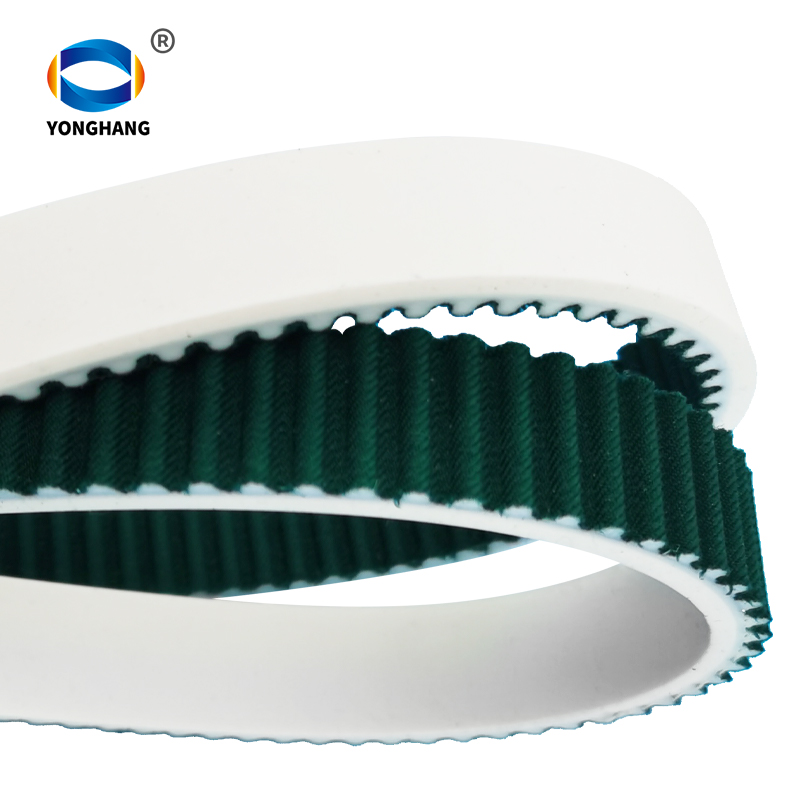
For open-end belts, special attention must be paid to the silicone treatment at the end clamping plates. The clamping area is prone to damaging the silicone coating, leading to delamination. When selecting a belt, verify whether the manufacturer has applied a delamination-resistant treatment or reinforcement to the ends.For closed-loop silicone coated timing belts, the splicing process is critical. Poor-quality splicing can result in silicone peeling at the seam or misalignment of the teeth. High-quality closed-loop silicone belts should utilize step-splice or mold-cured one-piece construction to ensure the seam strength matches that of the belt body, with a smooth surface free of protrusions that could compromise the stability of material conveyance.
III. Model Selection Decision Table
For a more intuitive selection process, please refer to the comparison table below:
| Dimensions | Open-ended silicone coated timing belt | Closed-loop silicone coated timing belt |
| Applications | Linear modules, gantry frames, automatic doors, textile machine traverse mechanisms | Conveyor lines, food baking lines, photovoltaic laminator feeders and unloaders, packaging lines |
| Motion Types | Reciprocating linear motion (slider-driven) | Continuous cyclic rotation (roller-driven) |
| Length Limits | Theoretically infinite length; cut to size on-site | Due to equipment wheelbase limitations, a fixed circumference must be specified |
| Installation Difficulty | Low (no need to remove the shaft assembly; secured with a clamping plate) | High (requires removal of the shaft assembly or the use of a shrink sleeve) |
| Interfaces/Connectors | Mechanical plating | Vulcanized splicing or seamless molding |
| Accuracy Characteristics | Flexible travel range, ideal for long-distance positioning | No joint misalignment, ideal for high-speed cyclic conveying |
| Cost Structure | Conveyor belt feeding is cost-effective, but requires matching profiles and clamping plates. | Custom mold costs are higher, but fewer accessories are required for installation. |
IV. Special Considerations and Common Misconceptions Regarding Silicone Coated Timing Belts
Misconception 1: Closed-loop belts are always more durable than open-loop belts.
This is not necessarily true. In long-stroke linear applications, if a closed-loop belt is chosen solely for the sake of “durability,” the excessive length of the belt can make it difficult to distribute tension evenly, which may actually lead to premature wear or stretching. Open-loop belts, equipped with a constant tension adjustment mechanism, often achieve a longer service life.
Misconception 2: Silicone coating only affects the surface and does not influence structural selection.
In reality, the silicone coating increases the belt’s thickness and flexibility. When selecting a closed-loop design, the belt’s minimum bending radius must be considered. Since silicone is relatively soft, using pulleys with too small a diameter may cause the silicone layer to delaminate from the tooth base layer. When selecting an open-loop design, an excessively thick silicone layer increases the resistance to slider movement, requiring a calculation of the motor’s thrust.