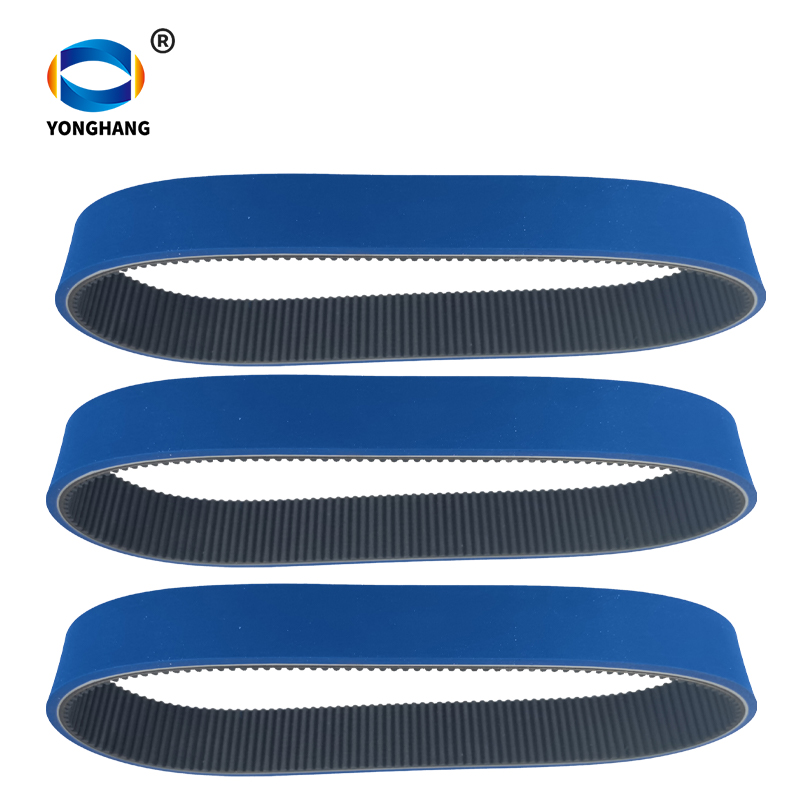
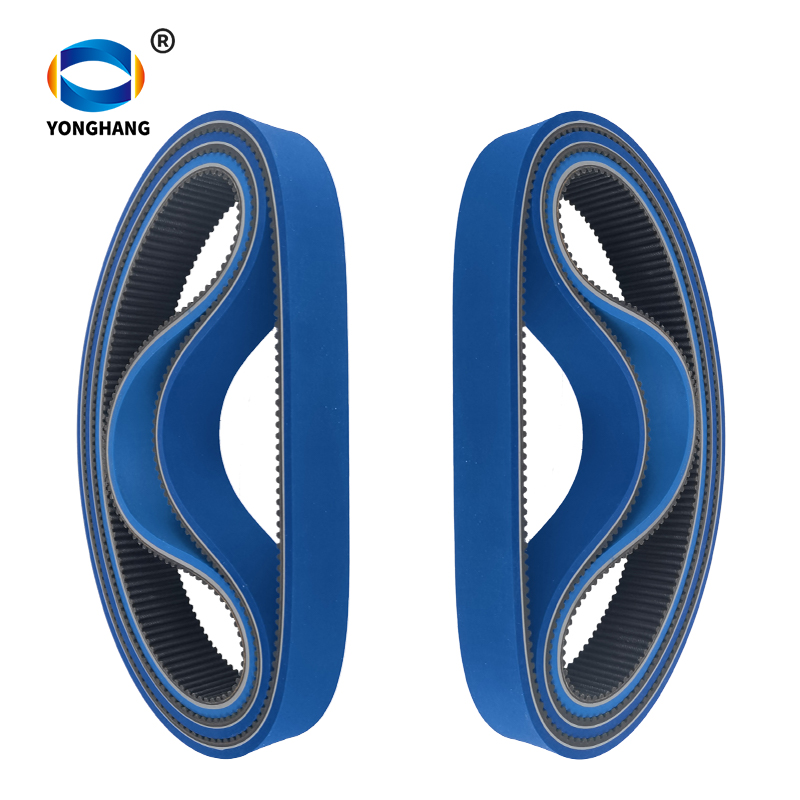
In modern industrial transmission systems, timing belts are widely used due to their precise transmission ratios and high efficiency. However, under certain extreme operating conditions—such as high or low temperatures, exposure to chemicals, high friction and wear, or applications requiring quiet operation—standard rubber or polyurethane timing belts often fall short. This is where silicone coated timing belt technology comes into play, serving as a key solution for enhancing timing belt performance. This article will provide an in-depth analysis of the operating principles of silicone coating and the mechanisms by which it comprehensively enhances the performance of timing belts, from the perspectives of materials science and surface engineering.
I. Key Properties of Silicone Coatings
Silicone (typically referring to addition-cured or condensation-cured liquid silicone rubber) possesses the following unique properties:
Wide-temperature stability: The operating temperature range extends from -55°C to +250°C, far exceeding that of traditional rubber (typically -30°C to +100°C).
Chemical inertness: Resistant to ozone, UV radiation, most acids, alkalis, and oil-based media.
Low Surface Energy: Surface tension of approximately 22–24 mN/m, providing excellent hydrophobicity and non-stick properties.
High Flexibility: Elongation at break can reach 300%–700%, with a low modulus of elasticity.
Biocompatibility: Non-toxic and odorless, meeting food-grade and medical-grade standards.
When these properties are transferred to the surface of the timing belt through a coating process, a series of synergistic enhancement effects are produced.
II. Five Principles for Enhancing the Performance of Silicone Coated Timing Belts
1. Principle of Expanded Temperature Resistance: Thermal Isolation and Thermal Buffering
Conventional timing belts experience rubber softening, tooth deformation, or even melting at high temperatures; at low temperatures, they become brittle and crack. The silicone coating addresses these issues through the following mechanisms:
Thermal buffering layer: The coating itself has low thermal conductivity (approximately 0.2–0.3 W/m·K), which delays the instantaneous transfer of heat to the belt’s base material.
Molecular Chain Stability: The main chain of silicone consists of Si-O-Si bonds, with a bond energy as high as 445 kJ/mol—far exceeding that of C-C bonds (347 kJ/mol). Consequently, the molecular chains are less prone to breaking or rearranging at high temperatures.
Low-Temperature Glass Transition: The glass transition temperature (Tg) of silicone is as low as approximately -120°C. Even in extremely cold environments, it retains its rubber-like state and does not undergo brittle fracture.
Practical Performance: Coated timing belts can operate stably over extended periods in ovens at 200°C or cold storage at -40°C, whereas standard belts can only withstand temperatures of approximately 80°C.
2. Mechanism of Friction Reduction and Wear Resistance in Silicone Coated Timing Belts: Self-Lubrication and Transfer Film Formation
Friction between the timing belt and the pulley is the primary source of energy loss and wear. The silicone coating achieves friction reduction through:
Low coefficient of friction: The surface friction coefficient of silicone (μ ≈ 0.2–0.4) is significantly lower than that of polyurethane (μ ≈ 0.6–0.8) or rubber (μ ≈ 0.7–1.0).
Transfer film effect: During the initial running-in period, trace amounts of silicone transfer to the pulley surface, forming a uniform solid lubrication film. This transforms the “belt-pulley” friction into “silicone-silicone” homogeneous friction, further reducing the coefficient of friction.
Abrasive particle entrapment: The soft silicone coating can trap hard abrasive particles (such as dust and debris), preventing them from embedding in the base material or scratching the pulley.
Quantitative Results: The silicone-coated timing belt exhibits a 30%–50% reduction in frictional power loss, and the wear rate of the belt teeth decreases by an order of magnitude.
3. Chemical Protection Barrier: Barrier and Passivation
In environments containing oil, solvents, acids, or alkalis, standard timing belts are prone to swelling, corrosion, or hydrolysis. Silicone coated timing belts provide three layers of protection:
Physical Barrier Layer: A dense silicone coating (typically 10–50 μm thick) prevents corrosive molecules from penetrating the substrate.
Hydrophobic Interface: Extremely low surface energy prevents water-based solutions from wetting the coating surface, creating a “lotus effect.”
Chemical Passivation: The methyl side chains in the silicone shield the main chain, making it resistant to attack by nucleophilic or electrophilic reagents.
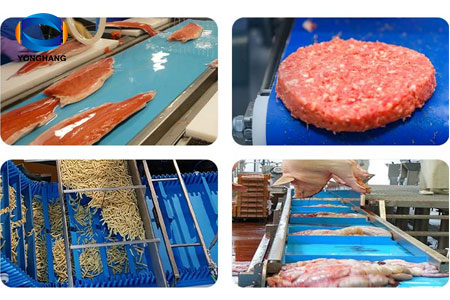
Typical Applications: In food processing lines where belts are frequently exposed to grease and cleaning agents, silicone-coated timing belts can extend service life by 3–5 times.
4. Enhanced Dynamic Fatigue Life: Stress Distribution and Crack Retardation
During repeated bending and stretching, microcracks can form on the surface of timing belts and gradually propagate, leading to failure. The role of the silicone coating:
Low-modulus stress buffering: The modulus of silicone (1–5 MPa) is significantly lower than that of the polyurethane substrate (20–50 MPa). The coating absorbs part of the bending strain energy, reducing peak stress on the substrate surface.
Crack Blunting Mechanism: When microcracks appear in the substrate, the soft silicone flows into the crack tips, increasing the radius of curvature and reducing the stress concentration factor (Kt can be reduced by more than 50%).
Absorption of Interfacial Dehazing Energy: A strong bond is formed between the coating and the substrate via chemical coupling agents (such as silanes). Crack propagation requires overcoming additional interfacial dehazing energy, thereby delaying failure.
Experimental data indicates that the flexural fatigue life (number of flexes to failure) of silicone-coated timing belts can be increased by 2 to 4 times.
5. Noise Reduction and Vibration Damping Mechanisms: Damping and Surface Smoothness
Transmission noise primarily originates from tooth-to-tooth impact and microscopic surface slippage. The principle behind the significant noise reduction provided by the silicone coating:
High damping characteristics: The loss factor of silicone (tanδ ≈ 0.1–0.3) is higher than that of ordinary rubber, enabling efficient conversion of vibrational mechanical energy into thermal energy.
Surface smoothing: The coating fills microscopic irregularities on the belt surface, reducing sudden changes in acceleration during tooth engagement.
Reduced contact stiffness: The soft coating extends the duration of the meshing impact force. According to the impulse theorem (F·Δt = Δp), this reduces the peak force.
Test results show that silicone coatings can reduce synchronous belt drive noise by 5–12 dB(A), making them particularly suitable for quiet environments such as office equipment and medical instruments.
III. Key Technical Points of the Coating Process
Achieving the aforementioned performance requires the preparation of a high-quality coating. Common processes include:
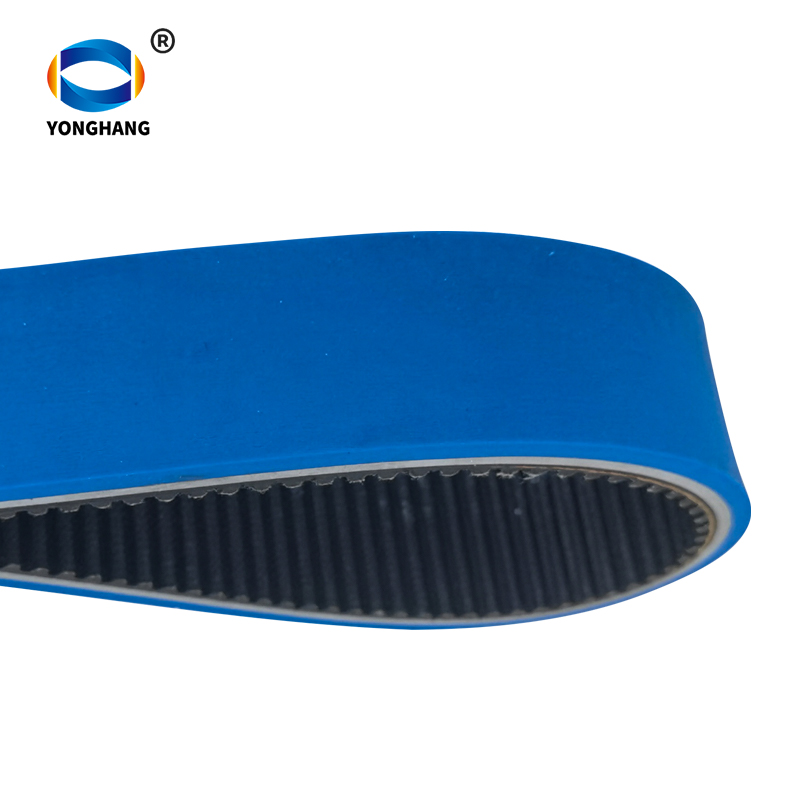
Dip Coating: The timing belt is immersed in a liquid silicone rubber solution and then cured by heating. This method is suitable for producing uniform, thin layers.
Spray Coating: A spray gun is used to apply a silicone rubber dispersion onto the surface of the belt, allowing for localized thickness control.
Mold Coating: The silicone layer is molded directly onto the belt body within a vulcanization mold, resulting in the highest bond strength.
The core technical challenge lies in interfacial bonding: ordinary polyurethane or rubber surfaces have low surface energy, making it difficult for silicone to adhere directly. This requires:
Activating the substrate surface through plasma treatment or a primer (such as a silane coupling agent).
Selecting a silicone formulation chemically compatible with the substrate (e.g., by introducing polar groups).
Silicone coating is not merely a surface treatment, but a systematic performance enhancement solution based on the material’s physical and chemical properties. Through multiple mechanisms—including thermal buffering, self-lubrication, chemical barrier protection, stress dispersion, and damping—it elevates the synchronous belt’s temperature resistance, wear resistance, environmental adaptability, and dynamic stability to a whole new level. With the refinement of coating processes (such as nano-composite silicone and gradient coatings) and advancements in interfacial bonding technology, silicone-coated timing belts will play an increasingly critical role in demanding transmission applications across high-end manufacturing, new energy, and medical and food industries.
In the future, the emergence of smart, responsive silicone coatings—such as those with temperature-self-regulating friction coefficients and self-healing capabilities for micro-cracks—may once again redefine the boundaries of timing belt performance.