Key Selection Criteria
Key Considerations for Selecting Timing Belts: Model selection requires comprehensive evaluation of transmission power, speed, operating environment, and space constraints. Choosing the correct type may even allow for narrower belts while maintaining performance, thereby optimizing equipment design.
Comprehensive Guide to Evaluating Transmission Power in Timing Belt Selection
In industrial transmission system design, timing belts are widely adopted for their precise transmission ratios, low maintenance requirements, and excellent load distribution capabilities. However, a common design fallacy involves simplistic selection based solely on motor rated power, which often leads to premature system failure, increased noise, or excessive costs. True reliable selection begins by understanding “transmission power” as a starting point that requires adjustment for comprehensive operating conditions, rather than an isolated, decisive figure. This article systematically explains how to comprehensively evaluate transmission power to achieve scientific, economical, and reliable synchronous belt selection.
I. Core Starting Point: From Theoretical Power to Design Power
The first step in selection is calculating the “design power,” determined by the formula:
Design Power (Pd) = Theoretical Transmission Power (P) × Operating Condition Coefficient (Ks)
Theoretical Transmission Power (P): Typically taken as the rated output power of the drive motor (e.g., servo motor, stepper motor). If the prime mover is an internal combustion engine, etc., its maximum continuous power must be used.
Operating Condition Factor (Ks): This is the critical factor in selection, quantifying the severity of actual working conditions on the transmission system. Ignoring Ks and selecting based solely on P is the primary cause of premature failure in most synchronous belts.
II. Comprehensive Evaluation Dimensions of Operating Condition Factor (Ks)
The operating condition factor Ks is not a single value but a composite assessment of multiple dimensions. Consult detailed synchronous belt coefficient tables to combine or select values.
Load Characteristics:
Smooth Load: Examples include fans, light-duty conveyor belts, and general machinery operating at constant speeds. Ks takes a smaller value.
Moderate impact loads: Examples include machine tool main drives, mixers, and printing machinery. Consideration must be given to start-stop cycles and load variations.
Heavy impact loads: Examples include crushers, presses, and heavy rolling mills. These involve intense vibration and sudden torque changes, resulting in significantly increased Ks values (potentially exceeding 1.5).
Daily Operating Hours:
Intermittent operation under 8 hours versus 24-hour continuous operation imposes vastly different fatigue life requirements on the belt. Continuous operation necessitates a higher Ks value.
Environmental Conditions:
Dust and Abrasives: Accelerate wear on belt teeth and pulleys, requiring increased coefficients or selection of specially protected belts.
Oil and Chemicals: May cause expansion, softening, and strength reduction in belt rubber/polyurethane materials.
Temperature: Sustained high temperatures (>60°C) or low temperatures (<-30°C) affect material properties. Special temperature-resistant materials must be selected and the coefficient adjusted.
Humidity: High humidity or water splashes may cause pulley corrosion, affecting meshing.
Tensioning and Alignment Conditions:
If system design cannot ensure long-term, precise alignment (e.g., insufficient structural rigidity) or if tension adjustment mechanisms are inconvenient, appropriately increase Ks to enhance safety margins.
Service Coefficient:
For critical equipment where downtime would cause significant losses, Ks may be increased as appropriate. Select more conservative (wider, stronger) specifications to achieve higher reliability.
III. Systematic Selection Process
During the selection process, the timing belt width serves as the core variable for achieving power matching.
Preliminary Selection: Based on Pd and the driven pulley speed, consult the Yonghang timing belt selection chart to preliminarily determine the belt type (e.g., MXL, XL, L, H, XH, representing pitch and size) and tooth profile (trapezoidal teeth/arc teeth; arc teeth offer higher transmission capacity and lower noise).
Determine Pulley Sizes and Length: Select the smallest pulley size while meeting the minimum bending radius (i.e., minimum pulley tooth count). Determine the larger pulley size based on the transmission ratio. Calculate and select the closest standard belt length using the preliminary center distance.
Verify rated power and determine belt width:
Look up the reference rated power (Po) for the specific belt type, tooth count, and speed in the selection table.
Key formula: Required belt width = Pd / Po × Timing belt width
Round the result up to the nearest standard belt width. If the result significantly exceeds the maximum standard width, return to the previous step and recalculate using a belt type with a larger pitch.
IV. Power Transmission: Critical Matching Factors That Cannot Be Overlooked
Even with flawless power calculations, neglecting the following factors can still lead to system failure:
Pulley Quality: Pulley material (aluminum alloy/steel), concentricity, and tooth slot machining precision must meet specifications. Substandard pulleys cause accelerated belt tooth wear.
Axial Parallelism and Tension: During installation, both pulley shafts must be parallel, and tension must be adjusted to the recommended value. Excessively loose tension can cause tooth skipping, while excessive tension reduces belt and bearing life.
Protection and Lubrication: Although timing belts do not require lubrication, proper lubrication of pulley bearings is critical. In harsh environments, consider adding protective covers.
Key Selection Criteria for Timing Belt Speed Drive
1.Selection of tooth profile and belt type: Based on the speed range
High-speed applications (V > 20 m/s, or n > 3000 rpm):
Prefer arc-shaped teeth (e.g., HTD/GT profiles): Their root stress distribution is more uniform, offering significantly superior bending fatigue resistance compared to trapezoidal teeth. They are the standard choice for high-speed designs.
Prefer smaller pitches: Smaller pitch belts (e.g., 3M, 5M) maintain lower centrifugal forces and meshing impacts at higher speeds while meeting power requirements.
Medium-to-low speed range (V < 10 m/s):
Trapezoidal teeth (e.g., T5/XL type) remain widely used due to cost advantages, but strict control of minimum pulley tooth count is essential.
Key principle: Higher speeds demand greater optimization of tooth profiles and manufacturing precision.
2.Pulley Selection: Minimum Tooth Count Rule Based on Speed
Minimum Tooth Count Requirement: Each belt type has a “recommended minimum tooth count” at a given rotational speed (consult Yonghang timing belt manufacturer for details). Higher speeds require a greater minimum tooth count.
Reasons:
Reduced Bending Stress: Increasing pulley diameter (i.e., adding teeth) reduces the bending curvature when the belt engages, significantly lowering internal bending stress.
Improved heat dissipation: More teeth engage in meshing, distributing heat more evenly.
Trade-off: Increasing tooth count means larger pulley diameter and higher cost. A balance must be found between “ensuring service life (more teeth)” and “controlling size and cost (fewer teeth)”.
3. Bandwidth Determination: Capacity Degradation Resulting from Compensation Speed
At high speeds, centrifugal force reduces the actual effective tension of timing belts. Therefore, after initially selecting a belt width based on design power, speed correction must be applied:
When selecting a belt, locate the belt width capable of transmitting the required power under the corresponding RPM column. At high speeds, the same belt type may require a wider belt width to compensate for centrifugal force loss.
Quick assessment: If the system operating point falls within the high-speed, low-torque region of the rating chart after initial selection, it typically indicates the need to verify sufficient belt width or consider switching to a belt type better suited for high speeds.
4. Systematic Selection Process and Speed Verification
Define design boundaries: Specify the system’s maximum operating speed, power, and spatial constraints.
Initial selection of belt type and tooth profile: Based on the maximum speed and referencing the above principles, preliminarily select the appropriate belt series (pitch) and tooth profile (trapezoidal/arc).
Determining Pulley Tooth Count:
Based on the initially selected belt type and maximum rotational speed, consult the Yonghang timing belt manual to determine the minimum permissible tooth count for the small pulley. Then, appropriately increase this count based on experience or structural requirements.
Calculate the number of teeth on the large pulley based on the transmission ratio.
Calculate and verify the pitch line speed:
Calculate the actual pitch line speed V.
Verify that it does not exceed the maximum allowable linear speed for this belt type/material (typically ≤80 m/s for polyurethane timing belts, higher for rubber timing belts).
Selecting Belt Length and Center Distance:
Set the center distance range based on the structure.
Calculate the required belt length and round it to the standard module length.
Note: Belt length also affects bending frequency; avoid using excessively short belts in high-speed applications.
Final Verification and Selection:
Using comprehensive selection software incorporating speed correction or detailed rating tables, input: rotational speed n, small pulley tooth count Z1, transmission ratio i, and design power Pd.
The system will output recommended belt widths meeting all conditions (particularly speed life). If the initial belt width is insufficient, increase the width or return to Step 2 to select a belt type with a larger pitch.
Material Selection: Rubber vs. Polyurethane:
This is a critical decision point in product selection. The two materials possess distinct characteristics and are suited for different application scenarios. A detailed comparison is provided below:
| Features/Requirements | Rubber timing Belt (Using Chloroprene Rubber CR as an Example) | Polyurethane timing belt |
| Wear-resistant/Dustproof | Ordinary | excellent, suitable for dust-free environments |
| Noise reduction | Superior performance, with tooth-surface fabric contributing to noise reduction. | Ordinary(But Nylon Fabric on Tooth Side (PAZ / NFT)Effective noise reduction) |
| Oil resistance | Some formulations (such as H-NBR) perform well. | excellent |
| Heat resistance | Excellent (up to approximately 120°C) | Ordinary (typically ≤ 85°C) |
| Hydrolysis-resistant/Moisture-resistant | Ordinary | excellent |
What are the most common issues encountered during timing belt use and how can they be resolved?
Slip and Tooth Skipping:
This is the most frequently encountered issue. Primary causes include insufficient tension, mismatched timing pulley and belt tooth profiles, significant installation misalignment, and excessive load.
The solution involves using a tension gauge to adjust to the standard value, while ensuring proper component matching and installation accuracy.
Tooth wear/chipping:
This is often caused by improper tension (too high or too low), excessive load, or poor meshing. Regular tension checks are required, and operation must be maintained within the rated load capacity.
Sagging of the belt:
The main reason is that the alignment of the shaft is poor or the pulley is not installed properly. The shaft axis needs to be recalibrated.
How do timing belts meet specific requirements such as high precision, high load capacity, or low noise?
For high-end equipment, general-purpose products often fail to meet specific performance requirements.
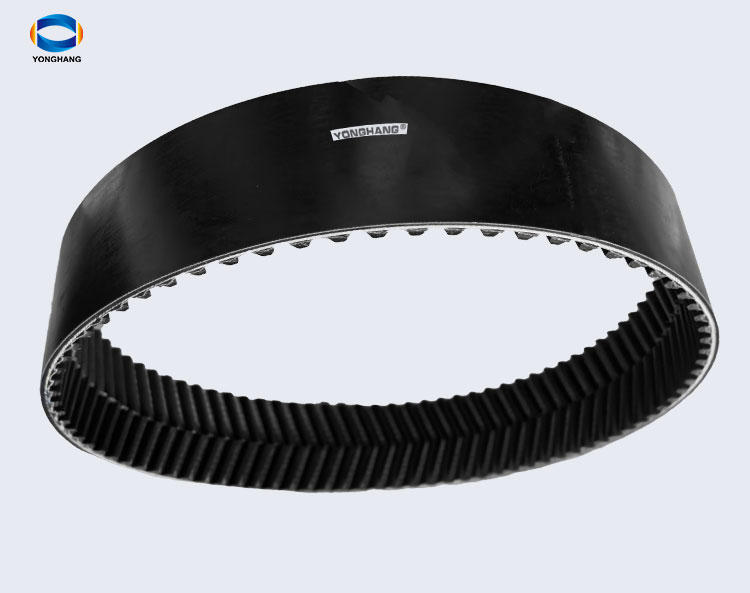
High Precision and High Load Capacity: Explore the latest herringbone synchronous belt technology. Compared to traditional trapezoidal/arc teeth, herringbone teeth eliminate axial forces through inclined contact surfaces, enhance meshing accuracy, and deliver greater transmission power with reduced vibration. As China’s leading timing belt manufacturer, Yonghang has developed and produced herringbone synchronous belts. For more information, contact us immediately.
Low noise and long lifespan: As shown in the case of the high-end elevator timing belt of Yonghang in the second paragraph, by using high-strength imported steel wire core and special production processes, although the price is three times that of ordinary products, it can significantly reduce noise, improve efficiency and extend lifespan. In the long term, it is more valuable.