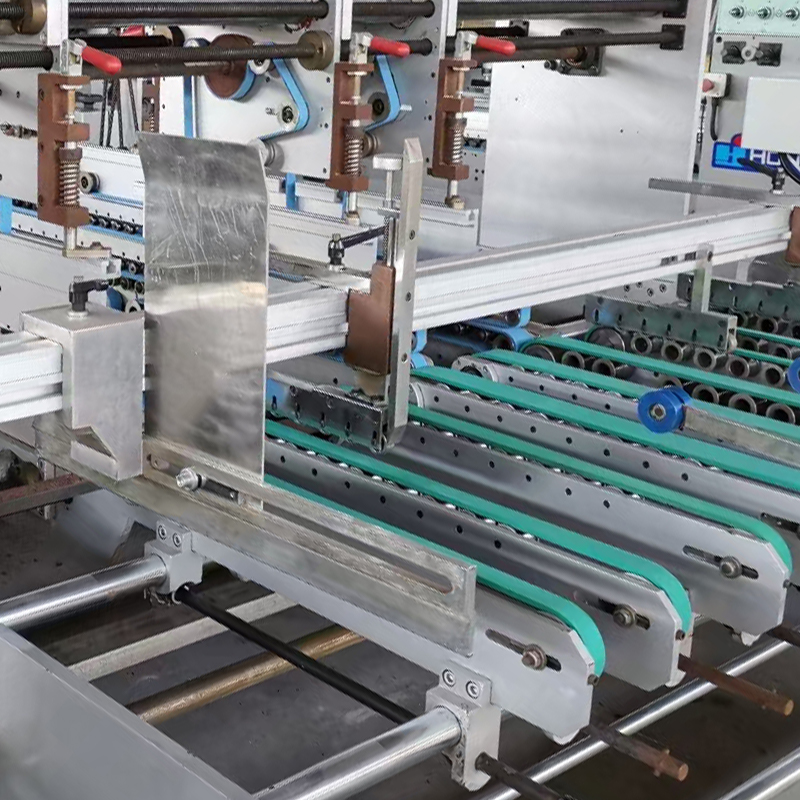
I. Glue folder machine Belt Misalignment Core Causes and Rapid Assessment
Installation and Structural Factors:
If the axes of the head and tail drums or the center idlers are not aligned with or parallel to the machine body centerline, the belt will be “pulled” toward the side with greater geometric error during operation. Unequal circumferences on both sides of the belt splice or an uneven splice will cause periodic serpentine deviation.
Material and Load Distribution:
When cardboard boxes or paper sheets are positioned off-center laterally on the belt surface, they cause the belt to “compensate” by drifting in the opposite direction. Single-sided stacking or improperly positioned paper guides can also disrupt lateral force balance.
Drum and Roller Conditions:
Paper or powder residue adhering to the drum’s outer surface, or rubber coating processing errors/uneven wear causing diameter inconsistencies on both sides, will cause the belt to drift toward the larger diameter side (commonly referred to in the industry as “drifting toward the larger diameter, not the smaller”). Roller jamming or bearing damage can also create resistance differences leading to misalignment.
Glue folder machine Body and Joints:
Inconsistent thickness/hardness on both sides of the belt body, uneven wear of the cover layer, beveled joints or abrupt thickness changes, as well as hardening due to prolonged use, all reduce straight-line stability.
Process and Environment:
Uneven suction/paper pressure on either side, misaligned guide/pressure rollers, residual lubricants/cleaning agents altering friction coefficients, and temperature/humidity fluctuations affecting material dimensional stability can all induce or exacerbate web misalignment.
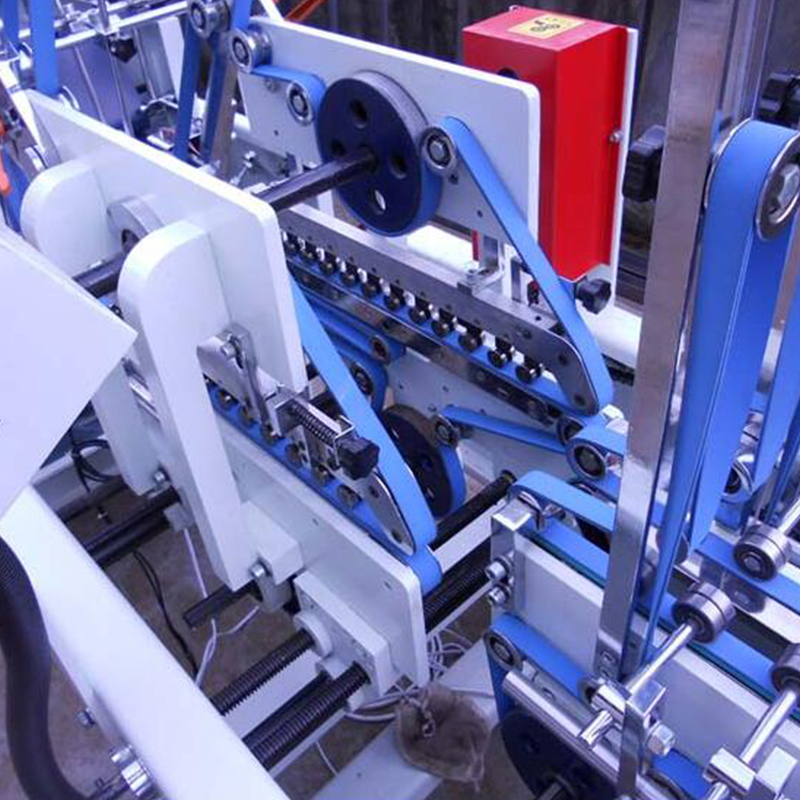
II. On-Site Adjustment and Optimization Steps
Head and Tail Drum Alignment and Tensioning:
Align head and tail drums using the machine frame as reference, ensuring bearing housing plane deviation ≤1 mm. Adjustment follows the principle: “If deviation occurs on one side, move the corresponding bearing housing forward (or move the opposite side backward).” Tail drum adjustment direction is opposite to the head drum. Simultaneously verify tensioning stroke and tensioner position to ensure balanced tension.
Idler Group Alignment:
Measure the deviation between the idler’s lateral centerline and the belt’s longitudinal centerline. Adjust if exceeding 3 mm. Follow the rule: “If deviation occurs on one side, move the corresponding idler group forward (in the running direction).” Adjust incrementally, symmetrically, and in small increments to avoid large single adjustments.
Material Handling and Guidance:
Adjust the position and pressure of the paper guide/stop to center the carton horizontally on the conveyor belt. If necessary, add or optimize guide plates to reduce “passive alignment” caused by single-side load imbalance.
Roller and Idler Maintenance:
Shut down to clean adhesive residue and accumulated powder from roller surfaces; repair or replace rollers with misaligned rubber covers or uneven wear. Inspect each idler for smooth rotation, replacing any stuck or damaged units to ensure even load distribution.
Joints and Belt Body:
Rework old joints exhibiting “flared edges,” thickness variations, or noticeable misalignment. Select belt thickness, hardness, and surface formulation matching the machine model. Replace the entire belt when necessary to restore geometric and friction consistency.
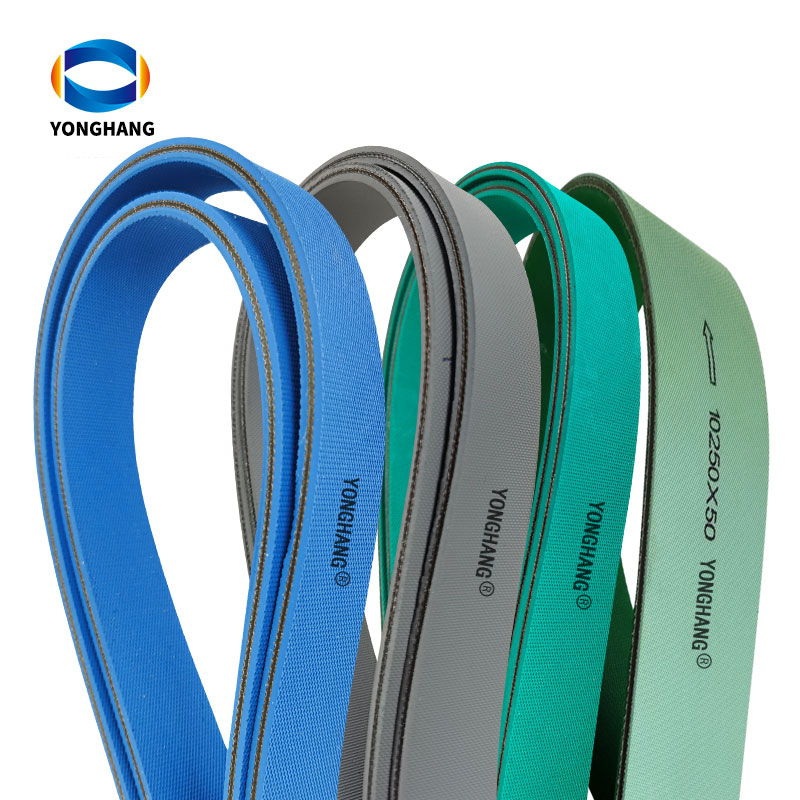
III. Glue folder machine belt Correction and Inspection During Operation
Low-Speed Test Run and Inspection: Begin operation with a low-speed idle run to observe the direction and location of belt deviation before gradually increasing speed. Record the section where deviation occurs and the operating conditions (load, speed, temperature, humidity) to facilitate root cause identification.
Fine-Tuning Tension and Guidance: Prioritize stabilizing the belt through alignment, guidance, and load distribution based on the principle of “minimum tension without slippage.” Avoid masking mechanical issues with excessive tensioning.
Cleaning and Media: Clean the belt surface and drums exclusively with water or neutral detergents. Strictly prohibit the use of strong solvents such as gasoline, banana oil, or acetone. Maintain symmetrical suction/pressure systems on both sides to prevent friction coefficient discrepancies.
Periodic Rechecks: Regularly verify alignment, parallelism, and bearing condition of head/tail drums and idlers; inspect belt wear, cracking, and splice flatness. Address anomalies promptly to prevent minor issues from escalating into systemic misalignment.
IV. Common Misconceptions and Corrections
“Greater tension does not prevent belt drift”: Excessive tension accelerates wear and heat generation, increases noise, and may induce vibration and speed loss. Focus primarily on alignment and guidance, using tension as a secondary measure.
Replacing belts without adjusting mechanisms: If material sticks to drums, idlers fail to rotate, or installation reference errors remain uncorrected, new belts will quickly drift again.
Ignoring material imbalance: Single-side loading or off-center material causes repeated belt tracking adjustments. Ensure material centering and optimize guidance first.
Using incorrect cleaning agents: Strong solvents can swell or dissolve protective coatings. Clean with non-volatile neutral agents, avoiding soaking or scrubbing.
Accepting substandard splices: Uneven joints or abrupt thickness changes cause vibration, speed loss, and premature fatigue. Reseal per specifications and recheck for consistent line speeds.
Recommendations from Yonghang Transmission Belt engineers with years of industry experience: Project success begins with precise selection of critical components. Safe and efficient procurement stems from professional, reliable suppliers. Contact Yonghang Transmission Belt—manufacturer of industrial belts, timing belts, and pulleys. Receive complimentary technical consultation and samples, free design services, and ready-to-use 3D drawings. Let our expert team safeguard your project. Leave specialized tasks to professionals for evaluation—achieve your goals efficiently and effectively.