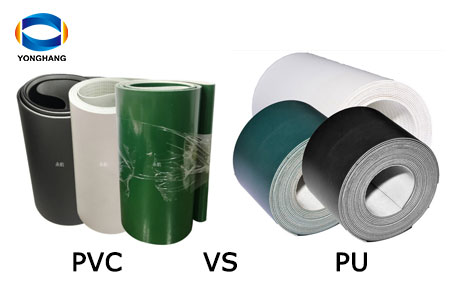
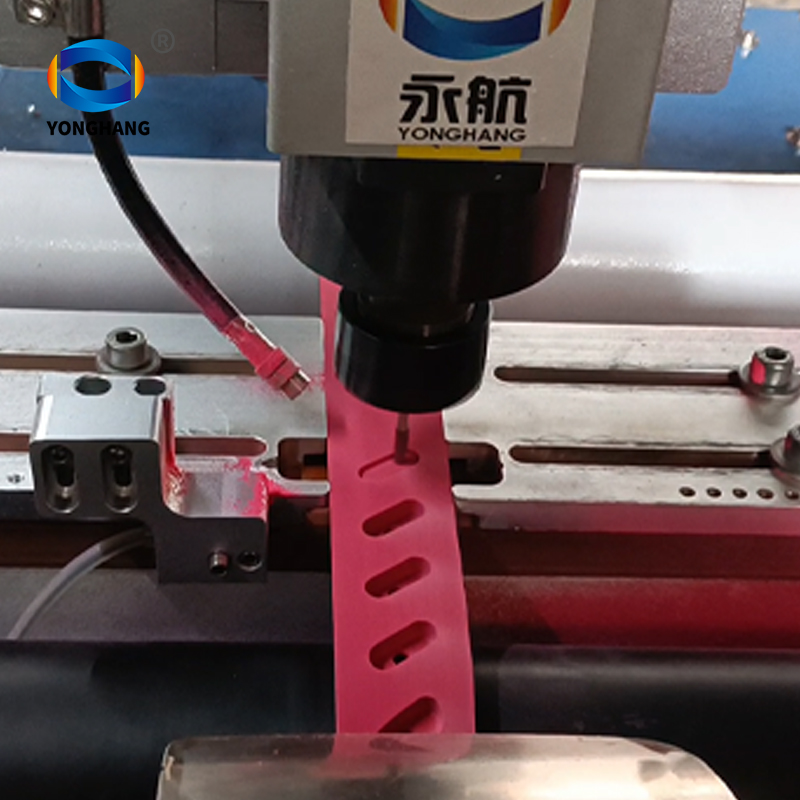
In the realm of industrial transmission, timing belts serve as core components for precise power and motion transfer, their value long transcending simple “transmission.” In recent years, a seemingly minor yet critically important secondary processing technique—precision hole punching for timing belts—has quietly emerged as an invisible engine driving industrial upgrading. By machining holes of specific positions, shapes, and dimensions with high precision onto polyurethane or rubber timing belts, this technology has expanded the functional boundaries of traditional timing belts. It transforms them from single-purpose transmission components into multifunctional intelligent carriers that integrate power transmission, positioning, vacuum adhesion, lightweighting, and signal interaction.
I. Five Key Industries Empowered by Technological Advancement
Timing belts perforation technology is driving the evolution of various industries toward automation, precision, and intelligence by addressing their core pain points.
1. High-End Packaging and Logistics Sorting Industry: Revolutionizing Dynamic Precision Handling
Pain Point: Rapid, damage-free grasping and placement of irregular, fragile items (e.g., snacks, pharmaceuticals, electronics) at high speeds.
Punching Solution: Precise perforation at suction cup or gripper mounting points enables vacuum-assisted negative pressure adhesion via connected systems below. Multi-hole timing belts handle multiple items simultaneously, with hole positions precisely synchronized to motion cycles, ensuring “dynamic grasping and release” during high-speed conveyance.
Upgrade Impact: Sorting efficiency increases by over 30%, damage rates drop to parts per ten thousand, enabling flexible packaging (single machine processing multiple product specifications).
2. Precision Electronics Manufacturing & Semiconductor Industry: Micron-Level Handling in Clean Environments
Challenge: Smooth, static-free, and particle-free handling of precision components like PCBs, chip carriers, and glass substrates in Class 1000 or Class 100 cleanrooms.
Perforation Enablement:
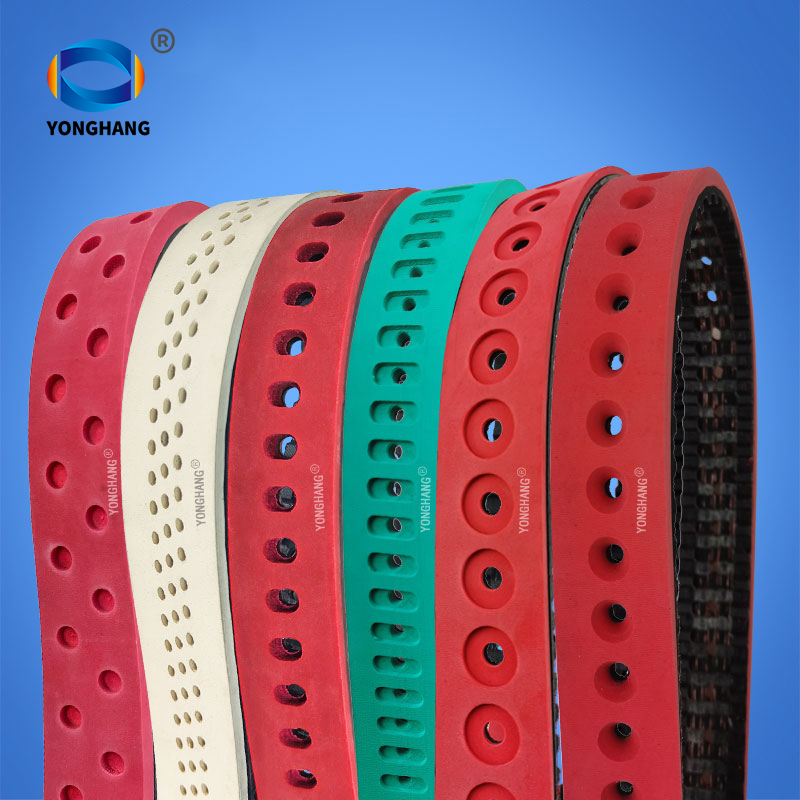
Vacuum Adhesion: Uniformly distributed micro-perforations generate large-area negative pressure, enabling stable full-surface adhesion of workpieces while avoiding stress and contamination from mechanical gripping.
Electrostatic Control: Utilizes anti-static materials and optimized hole patterns to minimize friction-induced charging.
Lightweighting and Dust Removal: Specific hole arrays reduce belt self-weight and generate micro-airflow during motion, aiding in the removal of minute dust particles.
Upgrade Benefits: Meets the stringent cleanliness and anti-vibration requirements of semiconductor front-end manufacturing (FAB), enhancing chip yield rates. Serves as a core technology for wafer handling robots and Automated Material Handling Systems (AMHS).
3. Digital Printing and Marking Industry: Infinite Loop and High-Precision Registration
Pain Point: During continuous digital inkjet printing or laser marking, achieving zero-error pattern registration while materials move at high speeds and accommodating material tension variations.
Punching Solutions:
Optical Positioning Holes: Circular or rectangular holes punched along timing belt edges or specific locations, paired with photoelectric sensors, create high-resolution optical encoders. This provides a more direct and precise position feedback system than traditional motor encoders, compensating in real-time for minor belt stretching or slippage.
Vacuum Adhesion Platform: Densely arranged suction holes on the belt securely hold substrates like paper or film, eliminating vibration.
Upgrade Benefits: Achieves ±0.1mm registration accuracy at speeds exceeding 120 meters per minute, supports variable data printing, and enables personalized packaging and on-demand production.
4. Food & Medical Device Industries: Hygiene, Safety & Traceability
Challenges: Production environments must meet stringent hygiene standards (e.g., FDA, HACCP), requiring equipment that facilitates thorough cleaning, prevents bacterial growth, and supports product traceability.
Punching Solutions:
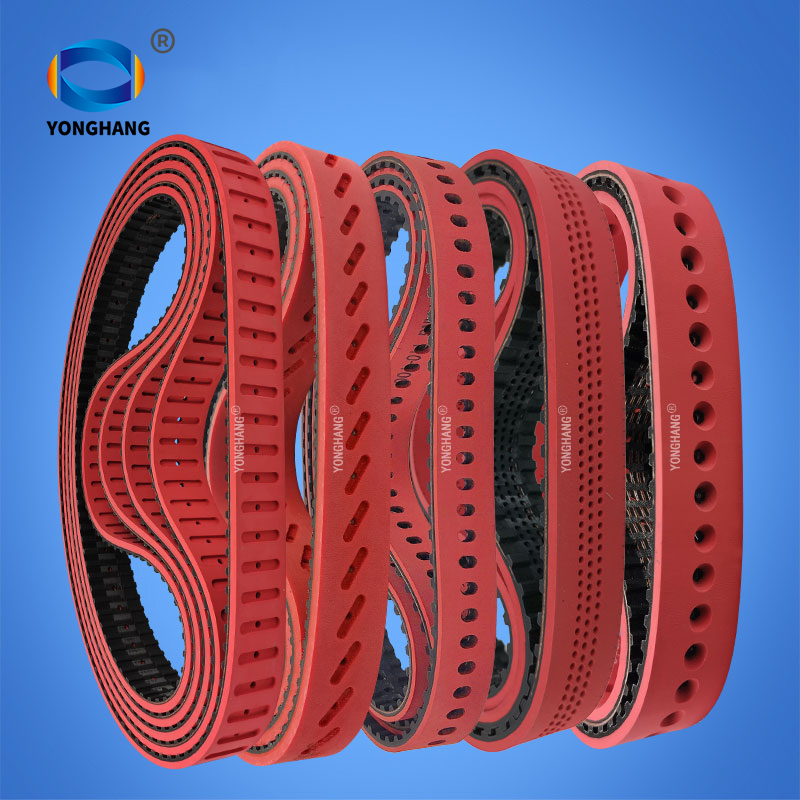
Drainage/Debris Holes: During cleaning, perforated belts allow water, steam, and detergents to penetrate and drain rapidly, preventing liquid accumulation and enabling in-situ cleaning.
Synchronization Positioning Holes: At filling, sealing, and labeling stations, positioning holes ensure each product is processed at precise locations, providing accurate station trigger signals for traceability systems.
Upgrade Benefits: Reduced equipment downtime for cleaning, enhanced hygiene and safety standards, and seamless data linkage from raw materials to finished products.
5. New Energy Vehicles & Aerospace Manufacturing: Lightweighting & Automated Assembly
Challenge: Automated assembly lines for battery packs, motor assemblies, or aircraft composite components require reliable handling of irregularly shaped, heavy-load, or high-value parts.
Perforation Solutions:
Customized Vacuum Chambers: Perforations zoned along the belt according to component contours create tailored suction areas for safe handling of battery modules, carbon fiber panels, etc.
Weight Reduction & Ventilation: Rational hole design minimizes moving component mass while maintaining strength, reducing drive energy consumption. During testing, holes also facilitate wire harness routing or sensor installation.
Upgrade Benefits: Enhances assembly line automation rates and safety, supports high-intensity, high-cycle production, and adapts to flexible, multi-model shared-line manufacturing demands.
II. Core Technologies: The Leap from “Processing” to “Empowerment”
The enabling foundation of timing belt perforation stems from three core technologies:
High-Precision Machining: Laser cutting or precision die-cutting ensures hole positioning accuracy within ±0.05mm, with smooth edges free of burrs that do not compromise the belt’s overall strength or lifespan.
Customized Design: Precisely calculates hole position, diameter, spacing, shape (round, square, slotted), and arrangement patterns based on application scenarios (adhesion, positioning, drainage).
System Integration: Perforated belts must seamlessly integrate with vacuum systems, sensors, and drive control systems to form an intelligent “motion-execution-feedback” closed-loop system.
Perforating timing belts—this precision micro-scale machining—essentially represents an innovation that directly “encodes” information (position) and functionality (adhesion, cleaning) onto the transmission carrier itself. It breaks down the traditional boundaries between transmission components and actuators, responding directly to the core demands of high-end manufacturing for “precision, efficiency, cleanliness, flexibility, and intelligence” through physical structural innovation. Looking ahead, as the Internet of Things and intelligent sensing technologies deepen their integration, perforated timing belts may further incorporate embedded sensors. They could evolve into smart transmission terminals capable of real-time monitoring of tension, temperature, and wear status, continuously providing foundational momentum for broader industrial upgrades. This precision “key” is unlocking the door to the next generation of intelligent manufacturing.