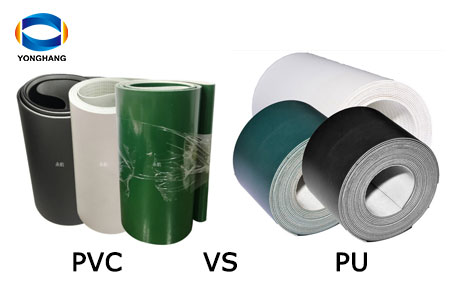
In the realm of precision transmission, PU timing belts have become core transmission components in automation equipment and precision instruments due to their outstanding wear resistance, high elasticity, and oil resistance. However, a frequently overlooked yet crucial design detail the tooth profile silently governs the overall physical properties of the timing belt. From classic trapezoidal teeth to modern arc-shaped and curved teeth, each profile represents a unique physical solution a delicate balancing act between strength, precision, noise levels, and service life.
PU Timing Belt Trapezoidal Teeth: The Classic Conflict Between Structural Strength and Meshing Impact
As the most traditional tooth profile, trapezoidal teeth are renowned for their simple geometry and high root strength. Their straight tooth flanks provide a large contact area during instantaneous meshing, effectively distributing transmission loads and demonstrating excellent shear resistance. This makes them particularly suitable for intermittent transmission scenarios involving medium to high torque. However, the Achilles’ heel of this profile lies in its inherent physical nature: the sharp corner at the bottom of the tooth groove tends to cause stress concentration, potentially inducing cracks under prolonged high loads. More significantly, during the instantaneous engagement and disengagement with the pulley, the straight tooth flanks make impact contact with the pulley teeth. This not only generates noticeable vibration and noise (typically reaching 70-75 decibels) but also accelerates crown wear. This is akin to an off-road vehicle: while it boasts a sturdy chassis, its ride comfort is subpar.
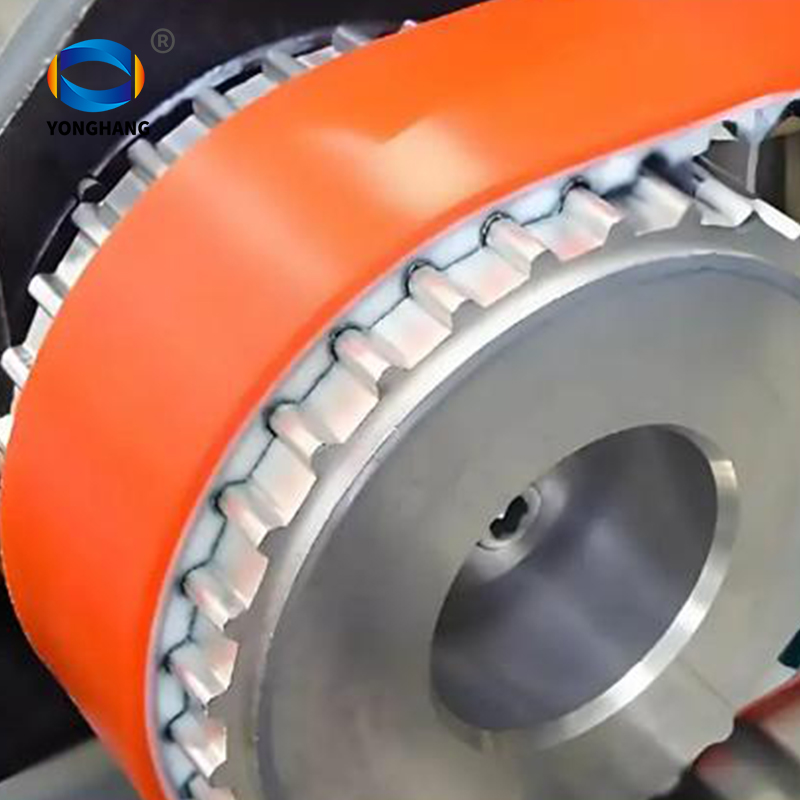
Arc-Toothed PU Timing Belts (e.g., HTD Profile): Optimized Stress Distribution and Precision Revolution
To overcome the inherent limitations of trapezoidal teeth, arc-toothed profiles emerged. Featuring single-arc or double-arc tooth profiles, their most significant physical advantage lies in dramatically improving stress distribution. The smooth profile eliminates stress peaks, enabling continuous and even load transfer along the tooth surface. This boosts the root bending fatigue limit by approximately 30%-40%. Simultaneously, curved meshing achieves smoother “rolling-in” and “rolling-out” motions, substantially reducing meshing shock and polygon effects. Operational noise can be lowered to 60-65 decibels. However, this performance gain comes at a cost: arc teeth typically feature a smaller tooth height. Compared to trapezoidal teeth, they may present a slight risk of tooth skipping under extreme overload or improper installation misalignment. It is akin to a high-performance sports car—prioritizing smoothness and efficiency while being more sensitive to calibration precision.
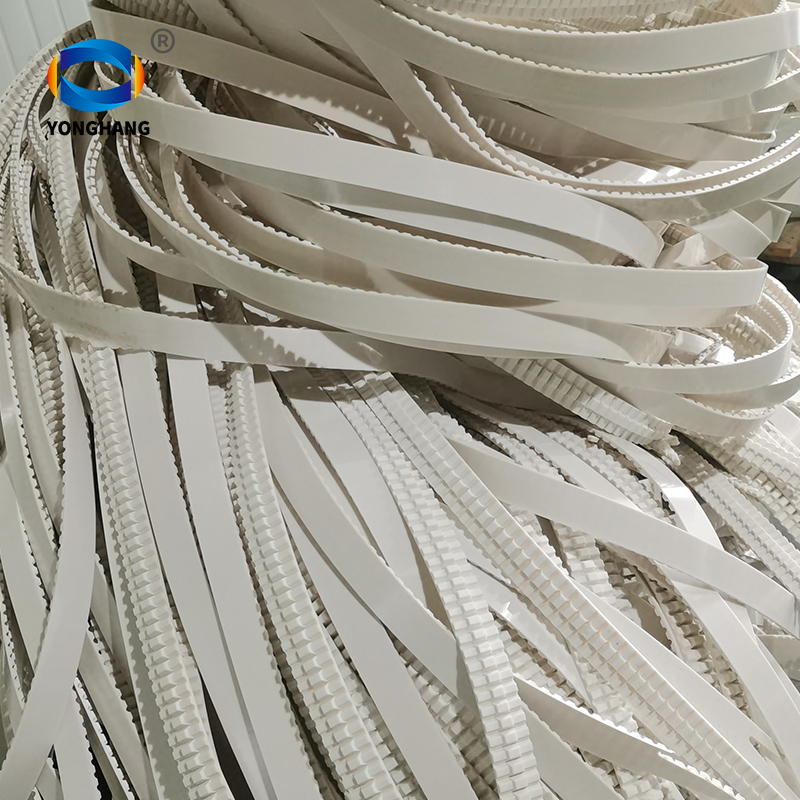
PU Timing Belts with Curved Teeth (e.g., STS/AT Profile): Reaching New Heights in Dynamic Balance
Curved teeth (such as parabolic profiles or more complex involute variants) represent the pinnacle of current tooth design. Through precise mathematical curves, they strive to maintain a continuous and nearly constant contact line throughout the entire meshing cycle. The physical advantages of this design are multidimensional: First, maximized contact area and extremely uniform pressure distribution further enhance the transmission’s torque capacity and service life. Second, near-perfect conjugate meshing reduces operational noise to extremely low levels (below 55 decibels), achieving “silent transmission.” Finally, its exceptional meshing precision minimizes microscopic slippage, making it particularly suitable for servo systems demanding stringent positioning accuracy. However, this ultimate performance comes with extremely high manufacturing requirements and costs, imposing near-demanding standards on pulley tolerances, parallelism, and system cleanliness.
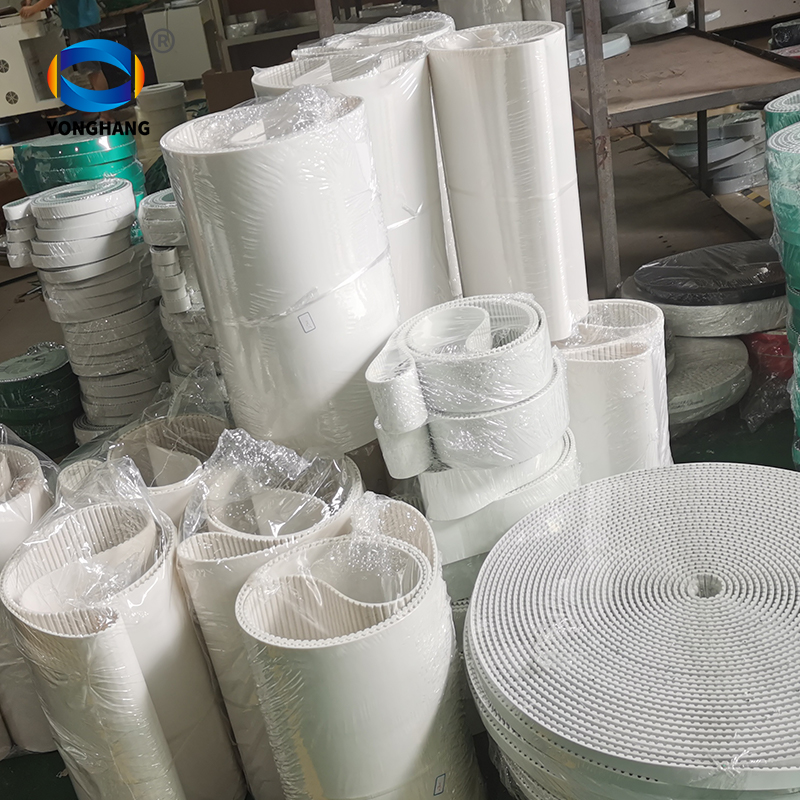
The Key to Selecting PU Timing Belts: Finding the Optimal Solution in the Physical Performance Matrix
Selecting the tooth profile essentially involves seeking the optimal solution within the physical constraints of a specific application scenario.
High-load, impact environments (e.g., conveyors, packaging machinery): Trapezoidal teeth or high-strength curved teeth become reliable choices due to their structural strength.
High-speed, low-noise scenarios (e.g., office equipment, medical instruments): Arc teeth and curved teeth offer unmatched advantages in dynamic stability.
Ultra-high-precision synchronous transmission (e.g., robotic joints, CNC machine tools): Curved teeth form the physical foundation for achieving nanometer-level repeatable positioning accuracy.
Space-constrained compact designs: Smaller pitch (denser tooth profiles) can provide greater effective contact tooth count, but bending fatigue life must be considered simultaneously.
The tooth profile of PU timing belts is far more than a simple geometric variation. From the ruggedness of trapezoidal shapes to the smoothness of arcs, and the sophistication of curves, each evolution in tooth design represents humanity’s deeper understanding and mastery of fundamental physical phenomena like friction, stress waves, vibration, and wear. In transmission system design, discerning the physical logic behind different tooth profiles is not merely a technical requirement for component selection—it is an art form that pushes mechanical efficiency, reliability, and quiet operation to their limits. Looking ahead, advancements in materials science and computational simulation may witness the emergence of novel tooth profiles grounded in interdisciplinary physical principles. Within the confined space of these teeth, the infinite possibilities of power transmission will continue to unfold.