In the precision realm of industrial transmission, the seemingly simple timing belt—where even minute variations in tooth profile can dictate the performance limits of an entire mechanical system—tells a story. The evolution of its tooth shape, from classic trapezoidal to modern high-performance arcs, is not only a chronicle of breakthroughs in materials science and mechanical design but also a testament to industrial manufacturing’s relentless pursuit of greater efficiency, lower energy consumption, and more precise control. Understanding the logic behind this evolution is key for every engineer seeking efficient and reliable transmission.
I. The Mark of History: The Era of Trapezoidal Teeth
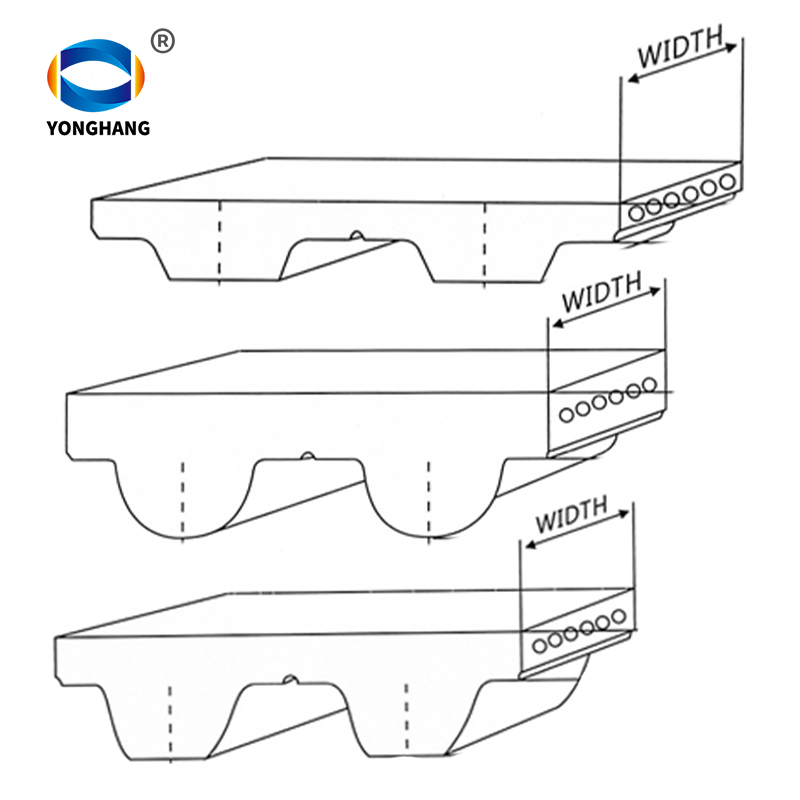
Trapezoidal teeth were the earliest standardized and commercialized timing belt tooth profiles. Their series designations—such as MXL, XL, L, H, and XH—remain widely used on many timing belts today.
Its design is simple and intuitive—a symmetrical isosceles trapezoid. In the early stages of industrial development, this design addressed the fundamental issue of “slippage” in belt drives, enabling precise synchronous transmission. However, as equipment speeds and load demands increased, the inherent physical limitations of trapezoidal teeth became increasingly apparent:
Stress Concentration: The sharp corners at the tooth roots act as natural stress concentration points, akin to creases in folded paper. Under alternating loads, these areas are highly susceptible to fatigue cracks, leading to tooth breakage.
Engagement interference: The process of teeth “slamming into” and “squeezing out” pulleys lacks smoothness, generating impact, vibration, and additional wear.
Performance ceiling: Noise levels, transmission efficiency, and service life plateau at certain thresholds, making further improvement challenging.Trapezoidal teeth stand as the “veteran” of industrial transmission—reliable, economical, and versatile. Yet, in the face of modern machinery pursuing exceptional performance, they increasingly show signs of being stretched beyond their capabilities.
II. Evolutionary Leap: The Rise of Curved Teeth
To overcome the limitations of trapezoidal teeth, engineers turned their attention to curves that better align with natural mechanical principles—specifically, arcs. This transition was not achieved overnight, but through continuous refinement from “semi-circular arcs” (as seen in early HTD designs) to “full-circle/parabolic teeth” (as found in modern RPP and GT series).
The core philosophy of curved tooth design is “following nature’s lead”:
Stress is evenly distributed: Smooth arcs eliminate sharp corners entirely, enabling load forces to transfer smoothly along the tooth profile and significantly enhancing root fatigue strength.
Engagement becomes smooth and quiet: The meshing process between belt teeth and pulleys transitions from “impact” to “rolling in,” significantly reducing shock and noise for higher-speed, smoother operation.
Performance achieves a comprehensive leap: Within the same installation space, arc-tooth synchronous belts deliver 30% to over 100% higher transmission power than trapezoidal teeth, with service life increasing exponentially.
Represented by the HTD (High-Performance Transmission) series, full-arc teeth have rapidly become the backbone of industrial automation. Subsequent derivatives like the AT series (high-precision type) and GT series (ultra-quiet parabolic type) address the extreme demands of servo systems and robotic joints for “zero backlash, high rigidity, and ultra-high precision.” Through micron-level optimization of tooth profiles, these belts push timing belt transmission into unprecedented realms of precision.
III. The Art of Selection: Matching the Optimal Tooth Profile for Your Application
When faced with a wide array of tooth profiles, the right selection logic matters more than memorizing specifications. Here’s a clear decision-making framework for timing belts:
Step 1: Define the Core Requirements of Your Application
Seeking ultimate cost control? → For low-speed, light-load, non-critical general-purpose transmission, trapezoidal teeth remain a reasonable choice.
Seeking reliable performance and durability? → For most industrial equipment, conveyors, and packaging machinery, high-performance arc teeth like HTD offer the most cost-effective modern solution.
Pursuing ultimate precision and dynamic response? → In CNC machine tools, industrial robots, and precision measurement equipment, AT or GT series are the undisputed standard—their value far outweighs the initial cost difference.
Step 2: Quantify Key Performance Parameters
Power & Torque: For high torque applications, prioritize STS or large-pitch HTD.
Speed: Beyond 1000 rpm, arc teeth deliver significant advantages in longevity and noise reduction.
Space Constraints: For high transmission in compact spaces, small-pitch 3M/5M (HTD) or GT2 profiles are the preferred choice.
Step 3: Evaluate Total Lifecycle Cost
Initial procurement cost is merely the tip of the iceberg. High-performance curved teeth often deliver lower total cost of ownership on critical production lines due to extended service life, reduced downtime, and minimal maintenance requirements.
IV. Looking Ahead: Beyond Tooth Profile
The evolution of timing belt tooth profiles vividly embodies the engineering spirit of relentless refinement. From trapezoidal to arc-shaped, the transformation extends beyond mere contours—it represents a shift in design philosophy: from functional compliance to performance optimization, ultimately aligning with the fundamental principles of natural mechanics.
Today, timing belt technology has transcended mere tooth profile optimization, advancing toward composite materials, precision manufacturing processes, and intelligent health monitoring systems. Yet its core principle remains unchanged: to transmit power and motion most effectively through scientifically optimized structures.Selecting the right tooth profile means choosing a reliable “transmission nerve” for your machinery. Understanding this evolutionary wisdom—from ‘trapezoidal’ to “arc”—on the blueprint of mechanical design will undoubtedly help you build a more powerful, quieter, and longer-lasting transmission system.