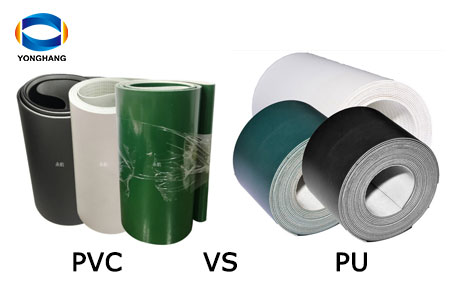
Price is superficial; performance is what truly matters.
When a sudden timing belt failure halts an entire production line, or when reduced transmission precision turns products into substandard goods, you’ll realize: the initial savings on procurement costs have long been repaid tenfold through downtime losses and quality claims. Timing belts aren’t consumables—they are the “tendons” of the transmission system. Their quality directly determines the equipment’s muscular strength and coordination. Move beyond price-only considerations. Let’s focus on the five core performance metrics that determine a timing belt’s reliability.
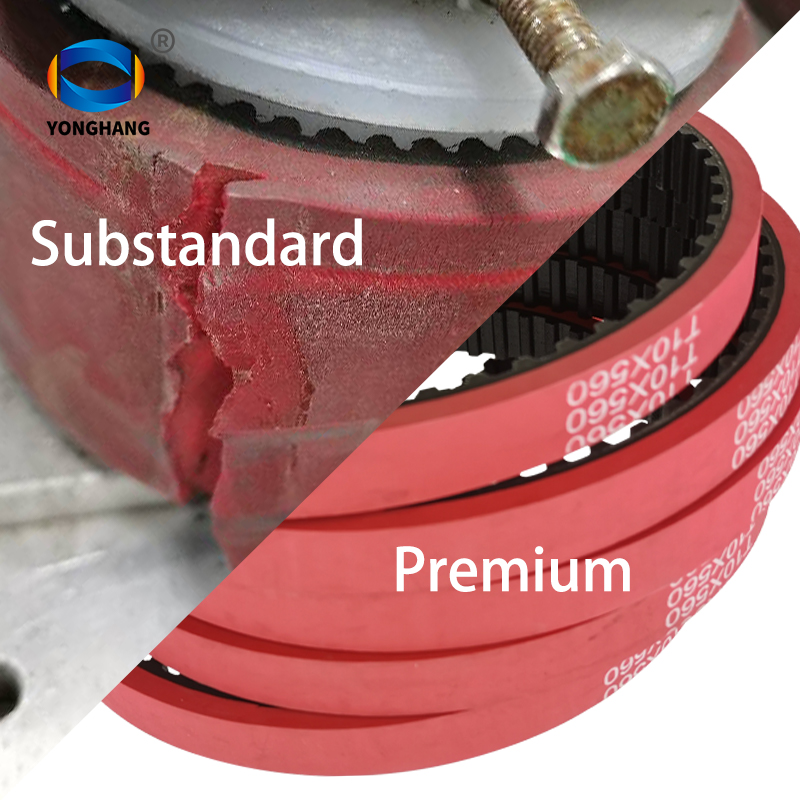
Indicator 1: Dimensional Accuracy and Consistency — The “Cornerstone” of Transmission
Why is it paramount?
A timing belt with poor dimensional accuracy is like ill-fitting shoes — tolerable initially, but inevitably leading to abnormal wear, noise, and efficiency loss. It forms the physical foundation for all performance characteristics.
Three critical dimensions to inspect:
Pitch Accuracy
What it is: The deviation between the center distance of adjacent teeth and the theoretical value.
How it affects equipment: Cumulative pitch errors cause transmission desynchronization and speed fluctuations, directly manifesting as machining errors or positioning inaccuracies in CNC machines and robots.
Quantified metric: Typically requires Cumulative Pitch Error to be less than ±0.1mm/100 teeth across the entire length (high precision grade).
Tooth Profile Accuracy
What it is: The conformity of the tooth profile shape to the standard tooth profile.
How it affects equipment: Inaccurate tooth profiles reduce the meshing area, leading to stress concentration, tooth skipping, and abnormal noise, significantly shortening the life of both the belt and pulleys.
Inspection Method: Requires comparison testing using a projector or gear measuring center.
Width/Thickness Uniformity
What it is: The consistency of belt width and thickness.
How it affects equipment: Inconsistencies cause uneven tension, belt drift during operation, and accelerated unilateral wear.
Simple Self-Check: Measure at multiple belt locations with calipers. High-quality belts should exhibit minimal variation (e.g., within ±0.2mm).
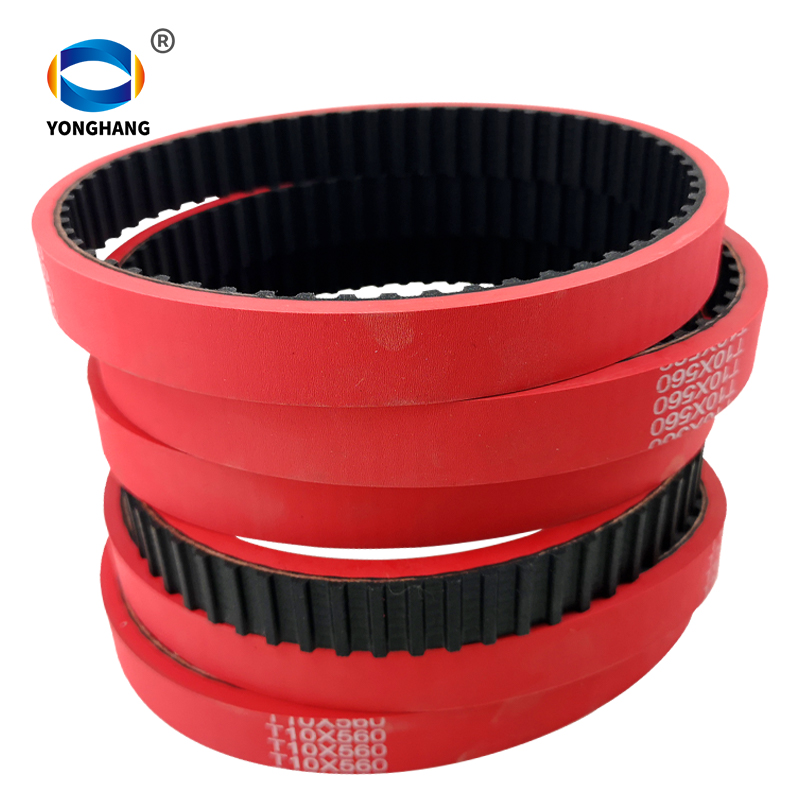
Indicator 2: Performance of the Tensile Layer (Core) — The “Backbone” of the Timing Belt
Why is it the source of strength?
The tensile layer bears over 95% of the tensile force during transmission. Its failure directly leads to belt breakage.
Materials and Structure
Glass fiber: Most commonly used, featuring high rigidity and low elongation, but poor resistance to repeated bending.
Polyester fiber: Excellent toughness and fatigue resistance, with slightly higher elongation.
Aramid fiber: Highest strength, lightweight, and exceptional fatigue resistance, used in high-performance, long-life applications.
Steel Cord: Used in polyurethane belts, offers zero elongation and ultra-high strength, but demands strict installation parallelism.
Tensile Strength and Elongation at Break
Tensile Strength: Determines the maximum tensile force the belt can withstand. Must exceed 5-8 times your calculated maximum working tension.
Tensile Strength at Defined Elongation (e.g., load at 1% elongation): A higher value indicates less deformation under working load, resulting in stiffer transmission and higher precision.
Fatigue Life
How it affects equipment: The core wire gradually fatigues and fractures from repeated bending around pulleys. This is one of the most common failure modes for timing belts.
Laboratory testing: Simulated testing via flexural fatigue testing machines indicates that high-quality belts should withstand over several million cycles of bending.
Indicator 3: Wear Resistance and Tear Resistance of Cover Fabric and Teeth — The “Armor” of Timing Belts
Why Does It Determine Durability?
The cover fabric and teeth directly contact and rub against pulleys while enduring meshing impacts. If they wear out or tear, the core cord becomes exposed to abrasion and corrosion.
Key Performance Characteristics of Premium Timing Belts
Tooth surface wear resistance: Nylon-covered fabric with tight weave; rubber/polyurethane tooth body with moderate hardness and excellent elasticity.
Resistant to lateral wear: Reinforced with twisted yarns on the sides or featuring a special coating.
Tear resistance: Rubber/polyurethane exhibits high bonding strength with core wires and fabric wrapping (high peel strength).
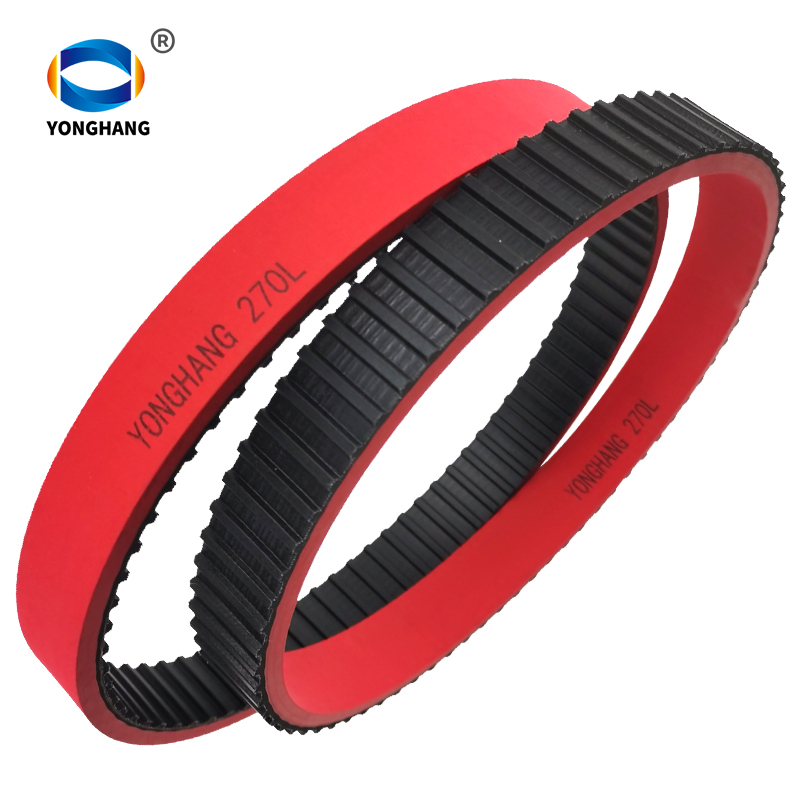
Indicator 4: Environmental Resistance —— The “Adaptability” of Timing Belts
Why Do Operating Conditions Determine Lifespan?
The working environment of timing belts is often their “silent killer.” Choosing the wrong material renders even superior performance futile.
Four Major Environmental Challenges and Solutions:
Oil and Chemical Resistance
Test Standard: Immerse belt samples in specified oils/chemicals (e.g., ASTM No. 1 Oil, No. 3 Oil) at high temperatures (e.g., 70°C) for a defined duration (e.g., 70 hours).
Qualified Performance: Minimal volume change rate (e.g., <20%), high strength retention rate (e.g., >80%). Polyurethane typically outperforms standard rubber.
Heat and Cold Resistance
High Temperature: Evaluates hardness change, strength retention, and service life degradation under sustained high temperatures (e.g., 90°C, 100°C). Hydrogenated nitrile rubber (HNBR) outperforms standard neoprene.
Low Temperature: Assesses flexural modulus at low temperatures (e.g., -30°C) to ensure resistance to brittle fracture.
Ozone and Weather Resistance
Critical: Essential for outdoor or ozone-containing environments (e.g., welding shops, near discharge equipment).
Testing: Place in a test chamber with 50-100pphm ozone concentration for a specified duration; surfaces should show no cracking. Chloroprene rubber has inherent advantages in this regard.
Anti-Static & Conductivity
Special Requirements: In textile, printing, or dusty environments, static buildup may cause fires or dust attraction.Indicator: Surface resistivity. Anti-static belts typically require resistance between 10^6 – 10^9 Ω, while conductive belts require resistance below 10^5 Ω.
Indicator Five: Dynamic Operational Performance — The Ultimate Litmus Test
Why Must Laboratory Data Be Validated in Practice?
The aforementioned indicators constitute a static “health checkup report,” while dynamic performance represents the “fitness test” of a timing belt during actual operation.
Three Key Dynamic Performance Factors:
Operating Noise Level
Sources: Imprecise meshing, excessively hard teeth, and improper tension all generate noise.
Impact: Beyond comfort, noise directly reflects transmission smoothness and wear status. A high-quality belt should operate quietly when correctly installed.
Transmission Efficiency and Temperature Rise
High transmission efficiency: Indicates minimal energy loss as friction heat. Calculated by measuring input/output torque and rotational speed on a test bench.
Temperature rise monitoring: After prolonged operation, belt temperature should not abnormally increase. Excessive temperature rise signals excessive internal friction, accelerating material aging.
Long-Term Operational Stability
Tension Retention Rate: After minimal initial elongation, a high-quality belt should maintain stable tension over extended periods, reducing the frequency of retensioning.
Wear Rate: After hundreds of hours of operation under simulated conditions, measure the wear in tooth thickness and width. Wear should be uniform and gradual.