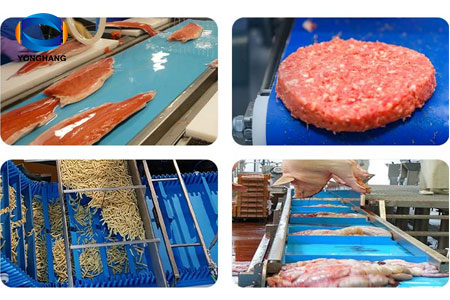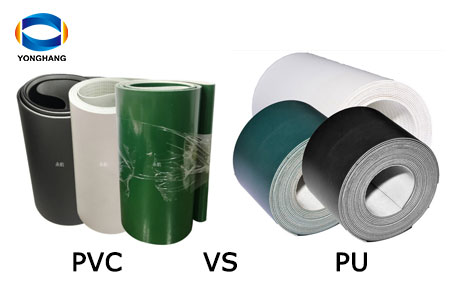
On automated production lines across food, daily chemical, and pharmaceutical industries, vertical packaging machines operate efficiently at hundreds of bags per minute. From granular snacks to powdered mixes, from hardware components to medical cotton swabs—behind it all lies an unassuming yet critical component: the timing belt. Like a precise conductor, it coordinates the core rhythm of the entire machine, serving as the silent guardian of packaging accuracy and efficiency.
I. Timing Belt: The “Heart Drive Chain” of Vertical Packaging Machines
The working principle of vertical packaging machines, in essence, involves transforming roll film into a tubular shape via a forming device, followed by longitudinal sealing, material filling, transverse sealing and cutting, ultimately forming individual packages. This complex sequence must be executed within strictly synchronized temporal and spatial coordinates.
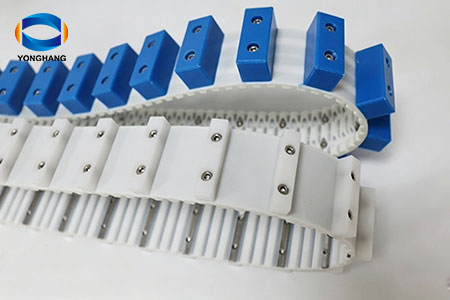
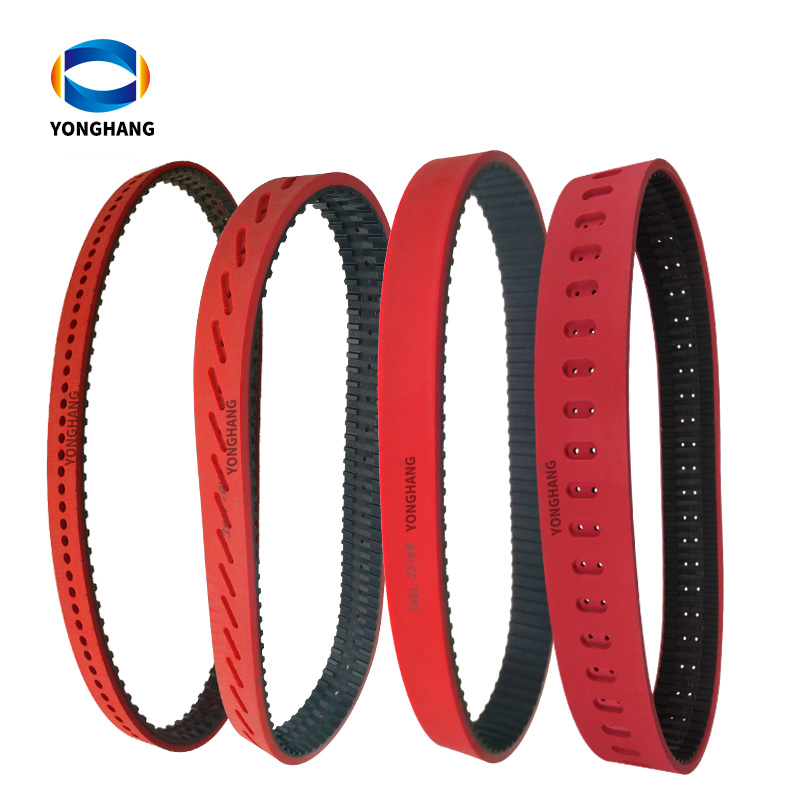
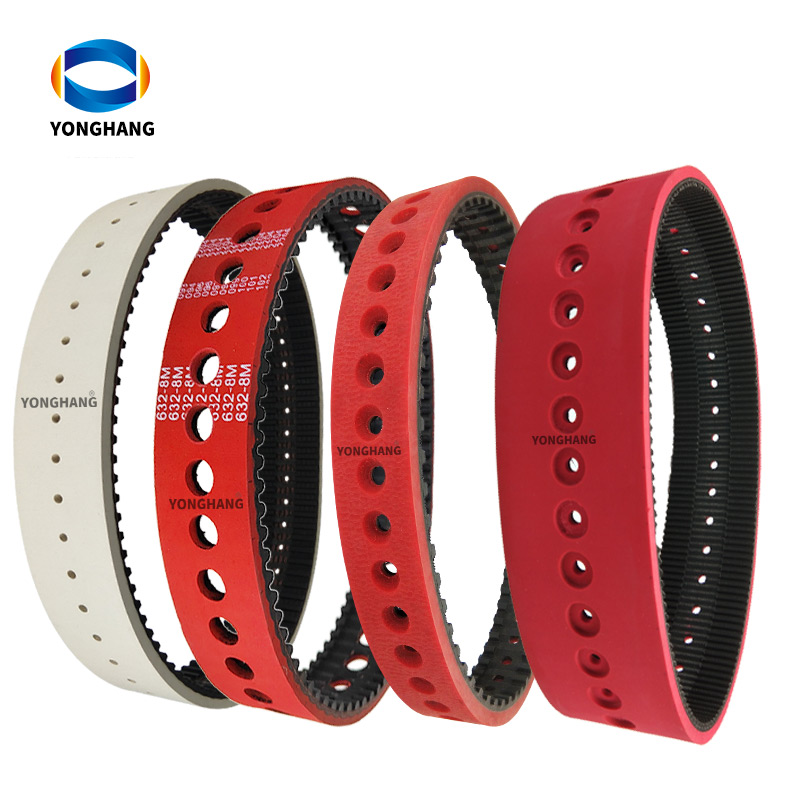
The timing belt plays a pivotal role by combining rigid transmission with flexible coordination. Unlike traditional chains or gears, it is a closed-loop belt integrating the precision of gears with the flexibility of belts. Its inner surface features precise teeth that mesh with the grooves of pulleys for power transfer. On vertical packaging machines, it primarily fulfills these critical functions:
Core Motion Synchronization: Precisely transmits power from servo or stepper motors, ensuring the cross-sealing and cutting mechanism arrives and completes the seal/cut precisely when material filling concludes. Even millisecond delays or advances cause misaligned packaging, spilled contents, or compromised seals.
Precise Position Control: Drives the film traction mechanism to pull the film at a constant or preset variable rhythm, guaranteeing exact bag length for every unit. This is critical for products requiring precise measurement, such as pharmaceuticals and premium condiments.Coordinated Auxiliary Devices: In high-end models, it may also synchronously drive auxiliary devices like coders and tear-notch punches, ensuring all actions seamlessly integrate with the main process.
II. Technical Core: The Trio of Materials, Structure, and Precision
A high-performance timing belt for vertical packaging machines represents the culmination of materials science and precision engineering.
Material Evolution: Early models predominantly used neoprene rubber, while today’s mainstream has shifted to polyurethane. Polyurethane offers superior abrasion resistance, tear strength, oil resistance, dimensional stability, and lower operational noise. Its backing (load-bearing surface) and teeth (meshing surface) may employ different formulations or fabric reinforcement layers (e.g., polyester cord, glass fiber) to address tensile stress and wear respectively.
Precision Tooth Profile: The most common profiles are trapezoidal teeth (e.g., T-type, AT-type) and curved teeth (e.g., HTD-type, GT-type). Curved teeth are increasingly favored in modern high-speed vertical packaging machines due to smoother meshing, more uniform stress distribution, and greater torque transmission capacity. The machining precision of tooth profiles demands extreme accuracy, with tolerances often controlled at the micrometer level.
Key Parameters:
Pitch: The distance between the centers of adjacent teeth, determining the transmission’s “resolution.”
Length Accuracy: The circumferential length precision directly impacts cumulative error; high-quality belts have extremely tight length tolerances.
Tensile Member: An internal steel wire or Kevlar fiber core ensures minimal elongation during high-speed operation, maintaining constant tension.
III. Selection, Maintenance, and Common Failures: Safeguarding the Lifeline of Efficiency
Proper selection and maintenance are prerequisites for maximizing timing belt performance.
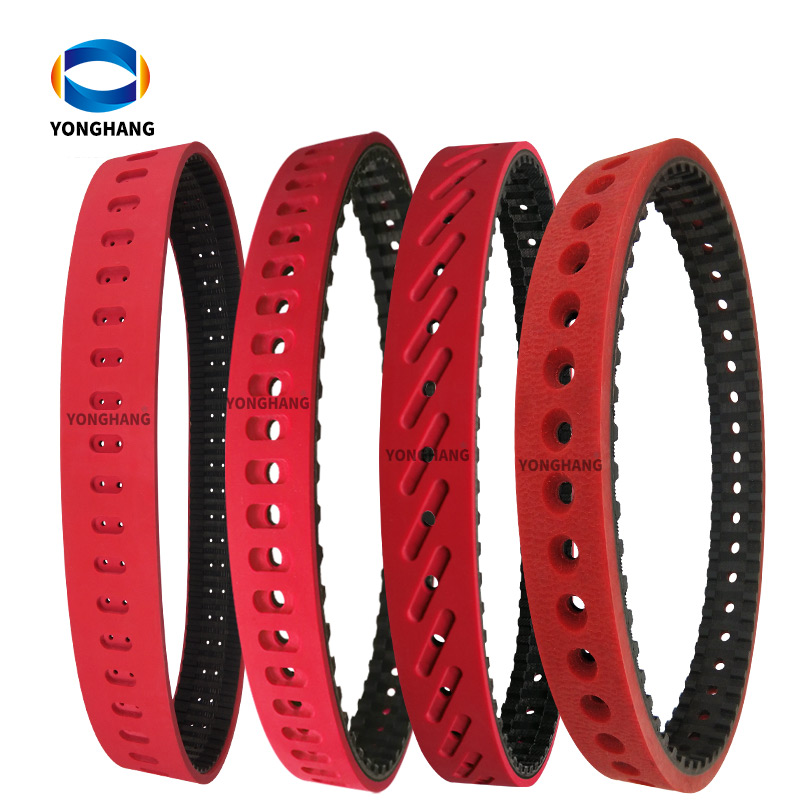
Selection Key Points: Engineers must calculate and determine the timing belt model, width, length, and material based on comprehensive factors including motor power and torque, designed transmission speed and acceleration, required precision grade, and production environment conditions such as temperature, humidity, presence of grease or dust. This is not a simple “like-for-like replacement.”
Core Maintenance:
Tension Adjustment: This is the most critical daily maintenance task. Insufficient tension causes tooth skipping and positioning inaccuracies; excessive tension accelerates wear and increases motor load. Regular inspection using a professional tension gauge is essential.
Alignment Calibration: Ensure all pulley shafts are parallel to prevent belt misalignment and side-edge wear.
Cleaning and Protection: Promptly remove dust and oil contamination, avoid chemical corrosion, and extend service life.
Common Failures and Impacts:
Skipping or Broken Teeth: Instantaneous loss of synchronization causes batch packaging scrap, requiring immediate shutdown and replacement.
Excessive Wear or Cracking: Leads to unstable bag length and gradual drift in sealing/cutting position, generating hidden defects.
Belt Elongation or Deformation: Inability to maintain tension prevents machine from reaching full speed, reducing efficiency.
Abnormal Noise: Often indicates improper installation, wear, or impending tooth skipping.
Company name: Guangzhou Yonghang Transmission Belt Co., Ltd.
Address: 4th Floor, Building B8, Chuangbao Creative Park, Federal Industrial Zone, West Yushan Road, Panyu District, Guangzhou,China.511400
Contact person: Cindy
Tel: +86-020-84898802
Fax: +86-020-84898803
Hand phone: +86 19864737116
E-mail: sales@yonghang-belt.com